

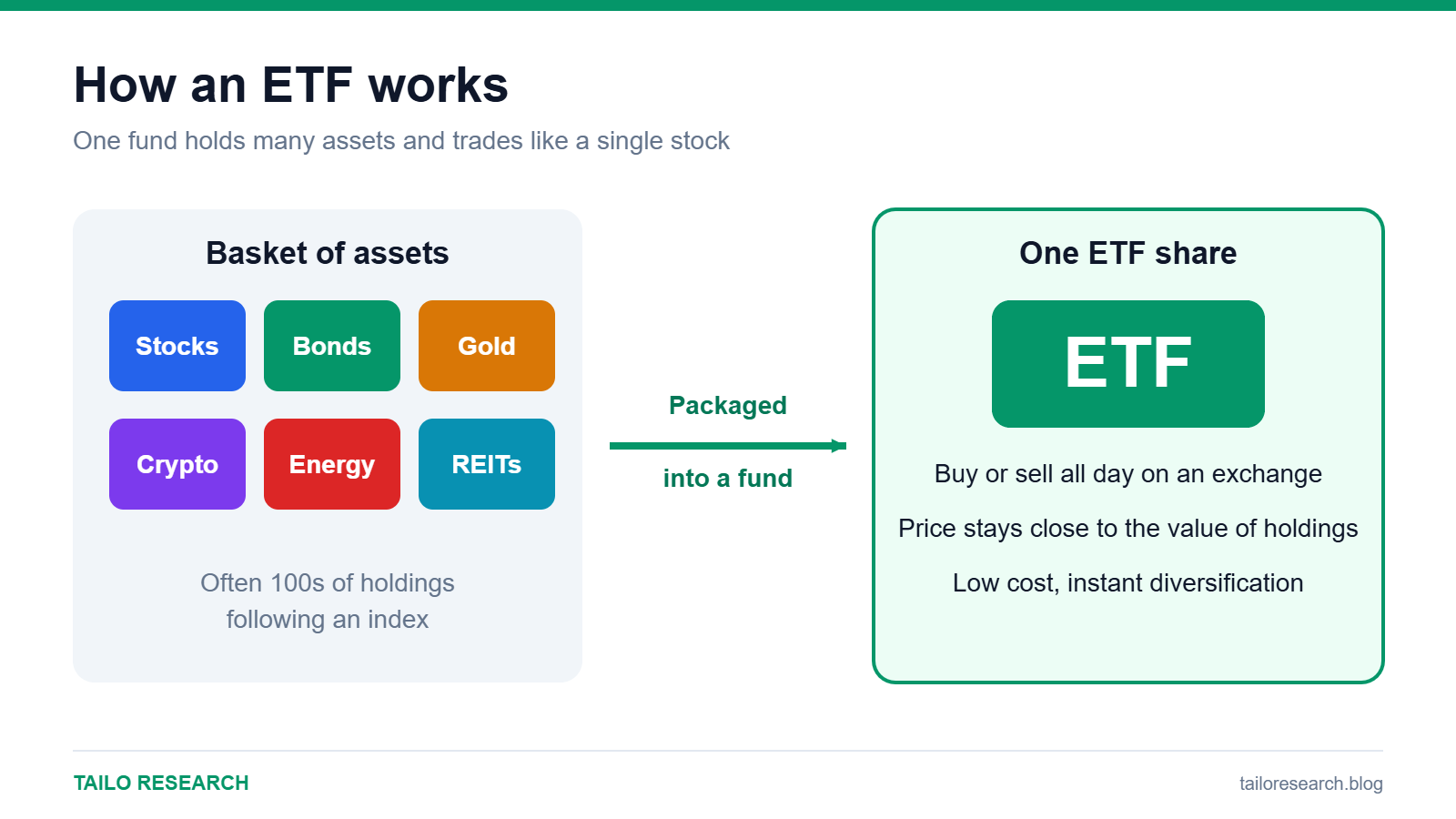
An exchange-traded fund, or ETF, is a fund that holds a basket of assets and trades on a stock exchange throughout the day, just like an individual share. Instead of buying 500 stocks one by one, you can buy a single ETF that holds all of them. That simplicity is why ETFs have become one of the most popular ways to invest in stocks, bonds, commodities and even crypto.
This guide explains how ETFs actually work, the main types, the costs that matter and the mistakes beginners make, so you can compare funds with confidence.
What an ETF is
An ETF pools money from many investors and uses it to hold a set of assets, usually following an index such as the S&P 500 or the Nasdaq-100. Each share of the ETF represents a small slice of that basket. When the assets in the basket rise or fall, the value of your ETF share moves with them. You can buy and sell it during market hours at the current market price, through any ordinary brokerage account.
How an ETF works behind the scenes
ETF shares are created and redeemed by large financial institutions called authorized participants. When demand for an ETF rises, an authorized participant delivers the underlying assets to the fund and receives new ETF shares. When demand falls, the process runs in reverse. This mechanism keeps the ETF’s market price close to the value of the assets it holds, known as net asset value (NAV). For very liquid ETFs the gap is usually tiny, but it can widen during stressed markets or for thinly traded funds.
The main types of ETFs
- Broad-market index ETFs track a large index such as the S&P 500 and give diversified exposure in one purchase.
- Sector and thematic ETFs focus on an area such as technology, energy, healthcare or artificial intelligence. They are more concentrated and more volatile than broad funds.
- Bond ETFs hold government or corporate bonds and are often used for income or to reduce portfolio volatility.
- Commodity ETFs track assets such as gold or oil, either by holding the physical asset or through futures contracts.
- Crypto ETFs give exposure to assets like Bitcoin through a regulated fund. Spot Bitcoin ETFs began trading in the United States in January 2024.
- Leveraged and inverse ETFs aim to deliver a multiple of, or the opposite of, an index’s daily move. They reset daily, so results over longer periods can differ sharply from what you expect. They are short-term trading tools, not buy-and-hold investments.
ETFs vs mutual funds vs individual stocks
| ETF | Mutual fund | Individual stock | |
|---|---|---|---|
| Diversification | Built in | Built in | You build it yourself |
| Trading | All day at market price | Once a day at NAV | All day at market price |
| Typical cost | Low expense ratio | Often higher | Trading commission only |
| Minimum investment | One share (or fractional) | Often a fund minimum | One share (or fractional) |
The costs that matter
- Expense ratio: the annual fee taken from the fund. Broad index ETFs can cost a few hundredths of a percent per year, while specialized funds cost more.
- Bid-ask spread: the gap between the buying and selling price. Liquid ETFs have very tight spreads; small funds can be expensive to trade.
- Tracking difference: how far the ETF’s return falls short of its index over time, mostly because of fees.
- Taxes: how ETF gains and dividends are taxed depends on your country and account type, so check local rules.
How to choose an ETF: a simple checklist
- Identify exactly what the ETF tracks and read the index description.
- Look at the top holdings and sector weights so you know what you really own.
- Compare the expense ratio with similar funds tracking the same index.
- Check assets under management and average daily volume as a sign of liquidity.
- Confirm the structure: does it hold the assets directly, or use derivatives or futures?
- Make sure it is available and tax-efficient in your country.
Common beginner mistakes
- Buying a fund because of its name without reading its holdings
- Owning several ETFs that hold mostly the same stocks
- Using leveraged or inverse ETFs as long-term investments
- Ignoring costs on small, niche funds
- Trading in and out too often and paying spreads each time
Key takeaways
- An ETF is a basket of assets that trades like a stock.
- Costs, holdings and liquidity matter more than the fund’s marketing name.
- Broad index ETFs suit long-term core investing; leveraged ETFs do not.
Related reading
- QQQ vs VOO: Nasdaq-100 or S&P 500?
- How to analyze a stock: a step-by-step framework
- Bitcoin for beginners: how it works and ways to trade it
Educational content only, not investment advice. Trading and investing involve risk, including the loss of your capital. Read our Risk Disclaimer and Affiliate Disclosure.


Leave a Reply