

VOO, VTI, SPY and IVV are four of the most popular ETFs for building a core US stock portfolio. Three of them (VOO, SPY, IVV) track the same S&P 500 index; VTI tracks the entire US stock market. This guide compares their costs, structures and use cases so you can pick the one that fits your account and trading style.
At a glance
| VOO (Vanguard) | IVV (iShares) | SPY (State Street) | VTI (Vanguard) | |
|---|---|---|---|---|
| Index tracked | S&P 500 | S&P 500 | S&P 500 | CRSP US Total Market |
| Holdings | ~500 | ~500 | ~500 | ~3,600+ |
| Expense ratio | 0.03% | 0.03% | 0.0945% | 0.03% |
| Structure | Open-end fund | Open-end fund | Unit Investment Trust | Open-end fund |
| Best for | Low-cost core investing | Low-cost core investing | Active trading, options | Total market exposure |
Why SPY costs more
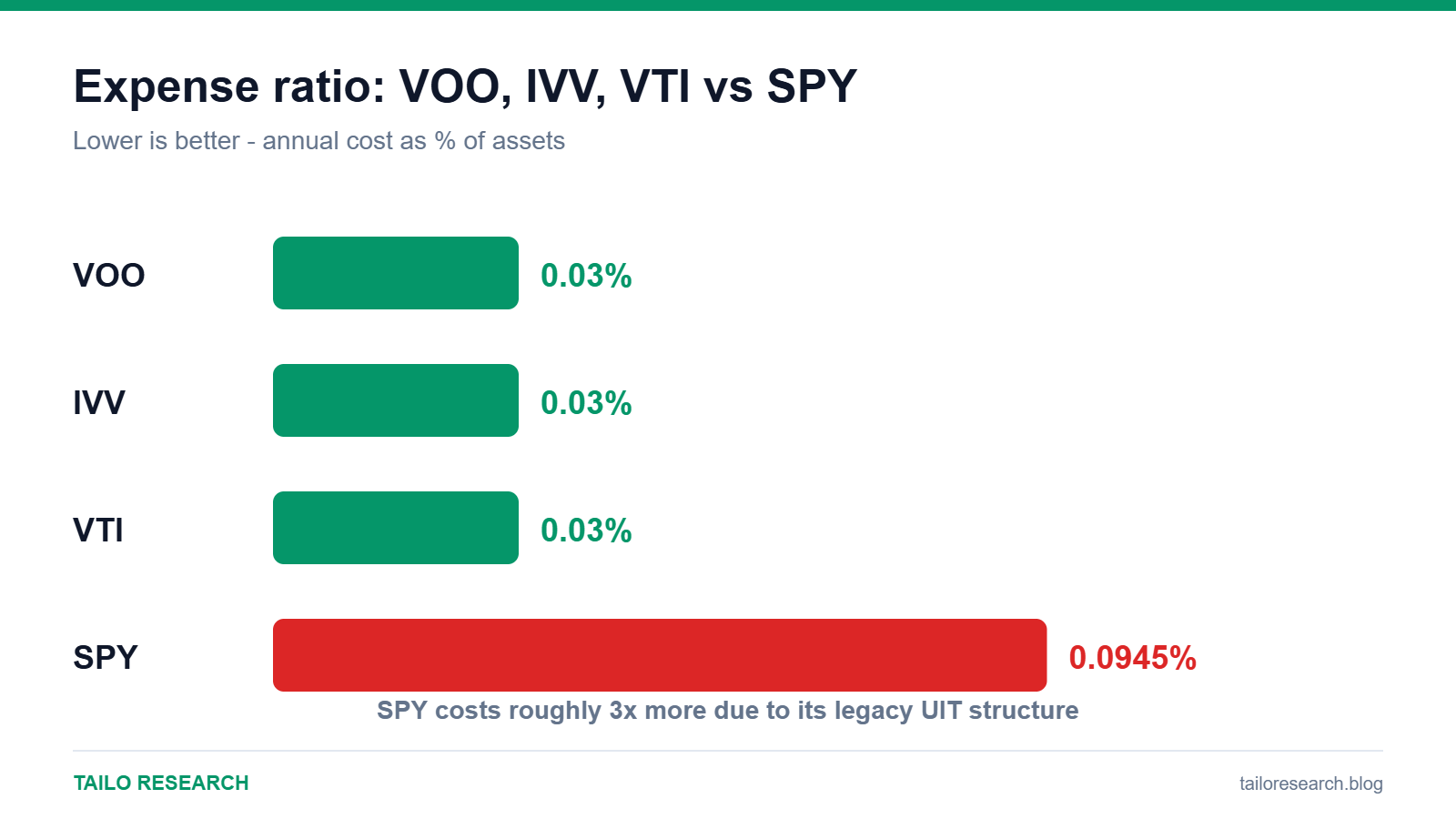
SPY is the oldest of the four, launched in 1993 as a Unit Investment Trust (UIT), a legal structure that predates modern ETF architecture. Under UIT rules, SPY cannot reinvest dividends the moment it receives them; instead it holds cash in a non-interest-bearing account until the quarterly distribution, creating a small performance drag known as dividend drag. VOO and IVV, structured as open-end funds, can reinvest dividends immediately, and their 0.03% expense ratio is roughly one-third of SPY’s 0.0945%. On a $10,000 investment held for 30 years, that fee gap alone can cost roughly $1,400 in foregone returns.
Why traders still prefer SPY
Despite the higher cost, SPY remains the most liquid ETF on the planet, with average daily volume far exceeding VOO or IVV. That liquidity translates into extremely tight bid-ask spreads and the deepest options market of any ETF, which matters for active traders running covered calls, protective puts or short-term strategies where execution cost outweighs the annual expense ratio.
VOO vs IVV: nearly identical
VOO and IVV both charge 0.03% and track the same index with about 99% portfolio overlap. The choice between them is largely personal preference between Vanguard and BlackRock as the issuer; some investors in taxable accounts note a marginal edge to IVV’s historical tax management, but the practical difference for most retail investors is negligible.
VTI: the total-market alternative
VTI holds essentially the entire US stock market, over 3,600 companies including small- and mid-cap names that the S&P 500 excludes. Because large-cap stocks dominate its weighting, VTI’s performance tracks VOO closely most of the time, but it adds modest diversification into smaller companies. Its 0.03% expense ratio matches VOO and IVV.
Which one fits which use case?
- DCA investor with regular contributions: VOO or IVV, for the lowest ongoing cost
- Active trader using options or frequent entries/exits: SPY, for liquidity and the deepest options chain
- Want small- and mid-cap exposure in one fund: VTI, for total-market coverage
- 401(k) investor: often no choice; your plan’s S&P 500 option is whichever fund it offers
For a broader look at how ETFs work, including costs and risk, see our ETF beginner guide and our QQQ vs VOO comparison if you are weighing a growth tilt against a broad core holding.
Key takeaways
- VOO, IVV and SPY track the same S&P 500 index; VTI tracks the whole US market.
- VOO and IVV are the cheapest at 0.03%; SPY costs roughly three times as much but offers unmatched liquidity and options.
- For most long-term, buy-and-hold investors, the lower-cost VOO or IVV is the more efficient default.
Want to trade what you read here as a CFD alongside TradingView charts? Open a Vantage account. This is an affiliate link: we may earn a commission at no extra charge from us. CFDs are complex instruments and carry a high risk of losing money rapidly due to leverage; most retail accounts lose money. See our Affiliate Disclosure and Risk Disclaimer.
Educational content only, not investment advice. Trading and investing involve risk, including the loss of your capital. Read our Risk Disclaimer and Affiliate Disclosure.


Leave a Reply