

Dividend investing means building a portfolio around companies and funds that pay out a portion of profits directly to shareholders. This guide covers how dividends work, the key metrics to check, and how dividend ETFs simplify the approach.
How dividends work
A dividend is a cash payment a company makes to shareholders, usually quarterly, out of its profits. To receive a dividend, you must own the stock before the ex-dividend date; the payment itself arrives on a separate pay date. Not all companies pay dividends: many growth-focused companies reinvest all profits back into the business instead.
Key metrics for evaluating dividends
| Metric | What it tells you | Watch out for |
|---|---|---|
| Dividend yield | Annual dividend as a % of share price | A very high yield can signal a falling share price, not strength |
| Payout ratio | % of earnings paid out as dividends | Above 80-100% can be unsustainable |
| Dividend growth streak | Years of consecutive increases | Dividend Aristocrats have raised payouts 25+ consecutive years |
| Free cash flow coverage | Whether cash flow actually covers the dividend | A dividend not covered by cash flow may get cut |
The dividend yield trap
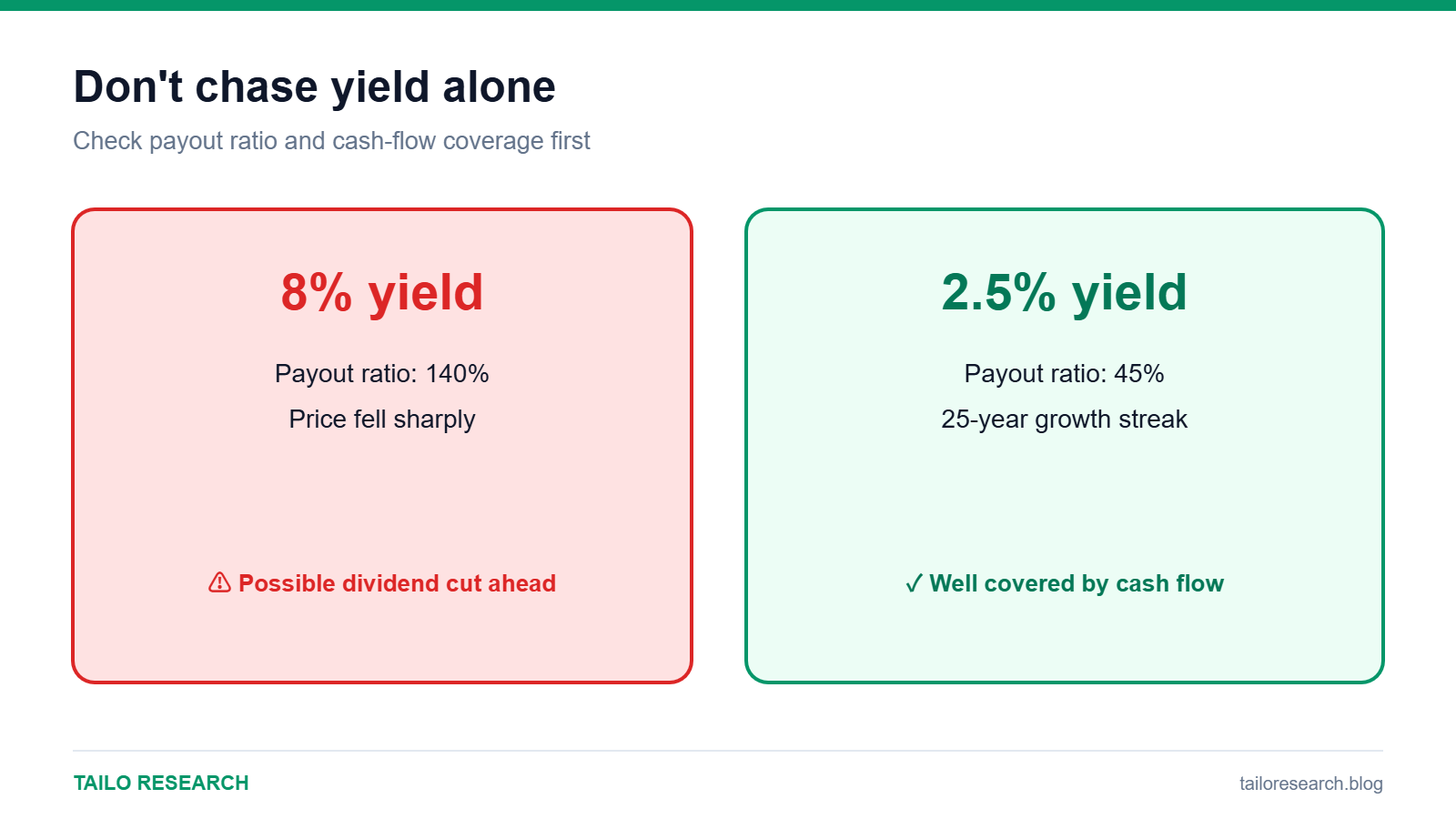
A stock yielding 8% is not automatically a better income investment than one yielding 2%. Often a spiking yield means the share price has fallen sharply, sometimes because the market expects a dividend cut. Always check the payout ratio and cash flow coverage before assuming a high yield is safe.
Dividend ETFs: a simpler approach
Rather than picking individual dividend stocks, many investors use dividend-focused ETFs, which hold a basket of dividend-paying companies screened by criteria such as yield, payout consistency or growth history. This spreads out the risk that any single company cuts its dividend.
- Dividend growth ETFs: focus on companies with long streaks of increasing payouts, prioritizing consistency over the highest current yield
- High-yield dividend ETFs: focus on the highest current yields, which can mean more exposure to sectors like utilities, energy or REITs
- International dividend ETFs: add exposure to dividend-paying companies outside the US
For the mechanics of how any ETF works, including costs and structure, see our ETF beginner guide.
Taxes on dividends
Dividend tax treatment varies significantly by country and account type. In the US, “qualified” dividends are taxed at lower long-term capital gains rates, while non-qualified dividends are taxed as ordinary income. Holding dividend investments in a tax-advantaged account can defer or reduce this tax drag, depending on local rules.
Key takeaways
- Check payout ratio and cash flow coverage, not just the headline yield, before trusting a dividend.
- Dividend ETFs spread single-company dividend-cut risk across a basket of payers.
- Tax treatment of dividends varies by country and account type, and materially affects net returns.
Want to trade what you read here as a CFD alongside TradingView charts? Open a Vantage account. This is an affiliate link: we may earn a commission at no extra charge from us. CFDs are complex instruments and carry a high risk of losing money rapidly due to leverage; most retail accounts lose money.
Educational content only, not investment advice. Trading and investing involve risk, including the loss of your capital. Read our Risk Disclaimer and Affiliate Disclosure.


Leave a Reply