

A futures contract is an agreement to buy or sell an asset at a set price on a set future date. Futures are traded on regulated exchanges and cover markets from stock indices and crude oil to gold, interest rates and Bitcoin. They are popular with active traders because they offer deep liquidity, nearly around-the-clock trading and efficient use of capital. They are also unforgiving to beginners who do not understand leverage.
This guide covers the mechanics you need to know before placing a trade: how contracts are specified, how margin works and where the risks are.
What is a futures contract?
Every futures contract is standardized by the exchange. It specifies what the underlying asset is, how much of it one contract represents, when the contract expires and how it settles. Because of this standardization, buyers and sellers do not negotiate terms; they simply trade at the quoted price. An exchange clearinghouse stands between both sides, which reduces counterparty risk.
Most traders never intend to take delivery. Index futures such as the E-mini S&P 500 are cash-settled, meaning no shares change hands. Traders simply close their position before expiry and keep the profit or loss. Some commodity futures can be physically settled, which is why speculators close or roll them before delivery.
Who trades futures?
- Hedgers such as farmers, airlines or fund managers use futures to lock in prices and reduce risk.
- Speculators such as retail and professional traders take on risk in the hope of profiting from price moves.
The key terms to understand
- Contract size (multiplier): how much money one full point of movement is worth. The E-mini S&P 500 (ES) is $50 per index point.
- Tick size and tick value: the smallest price increment and what it is worth. ES moves in 0.25-point ticks, worth $12.50 each.
- Expiration and rolling: contracts expire on set dates. Traders who want to stay in a position “roll” it into the next contract.
- Margin: a good-faith deposit required to open a position. It is a small percentage of the contract’s total value, not a down payment.
- Mark-to-market: gains and losses are settled in your account every day, so you can receive a margin call quickly.
A worked example of leverage
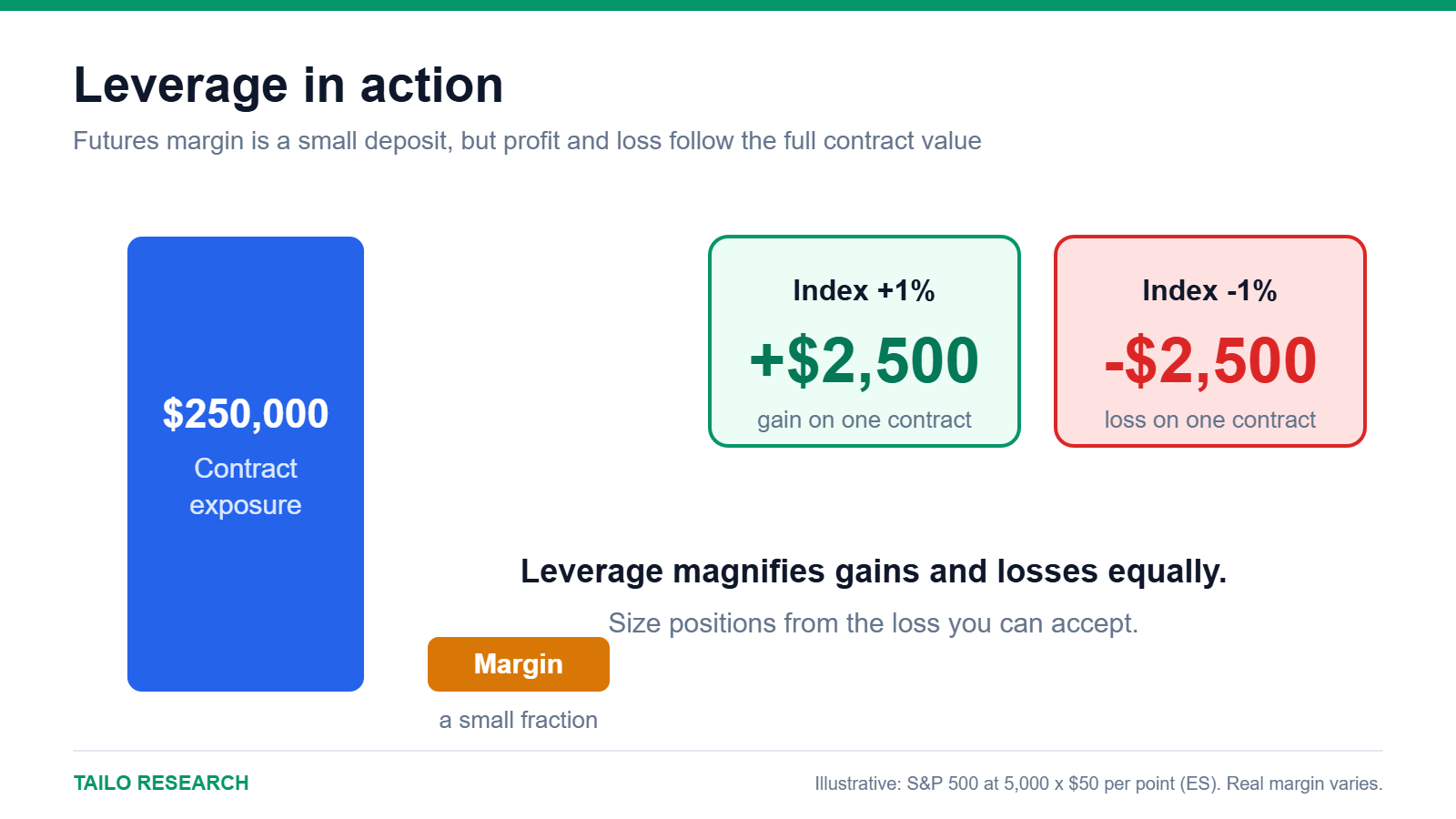
Suppose the S&P 500 index is at 5,000. One ES contract then controls roughly $250,000 of exposure (5,000 x $50). You might only need to post a small fraction of that as margin. If the index rises 1%, the contract gains $2,500. If it falls 1%, you lose $2,500. Leverage magnifies gains and losses equally, and this is the single most important idea in futures trading. (Illustrative figures; actual margin varies by broker and market conditions.)
Popular futures markets
- Equity indices: E-mini and Micro E-mini S&P 500 (ES, MES) and Nasdaq-100 (NQ, MNQ)
- Energy: crude oil and natural gas
- Metals: gold, silver and copper
- Rates and currencies: Treasury futures and major currency pairs
- Crypto: Bitcoin and Ether futures listed on regulated exchanges
Futures vs stocks vs CFDs
| Futures | Stocks | CFDs | |
|---|---|---|---|
| Where traded | Regulated exchange | Stock exchange | Over the counter, with a broker |
| Leverage | Built in through margin | Only with margin accounts | Built in, set by broker and regulator |
| Expiry | Yes, contracts expire | No | Usually no, with daily financing |
| Trading hours | Close to 24 hours on many index contracts | Exchange hours | Follows the broker and underlying market |
If you are weighing derivatives, our guide to what CFD trading is and how it works covers the differences in detail.
The main risks
- Leverage risk: losses can exceed your initial margin.
- Gap risk: prices can jump past your stop, especially around economic releases and overnight.
- Margin calls: if your account falls below maintenance margin, positions may be closed for you.
- Rolling and liquidity: less-liquid contracts can have wider spreads.
- Overtrading: it is easy to take too much size because each trade feels cheap to open.
How beginners can start more safely
- Learn the contract specifications of one market before trading it.
- Practice on a demo or simulated account until you can follow a written plan.
- Start with micro contracts, which are one-tenth the size of standard ones. Our guide to Micro E-mini Nasdaq-100 (MNQ) futures is a good example.
- Decide your maximum loss per trade in dollars before entering.
- Learn to read levels and price action, starting with support and resistance.
Key takeaways
- Futures are standardized contracts with leverage built in.
- Know your contract size, tick value and margin before trading.
- Risk management matters more than any entry signal.
Prefer to trade index exposure through CFDs with a TradingView-connected platform? Open a Vantage account. This is an affiliate link: we may earn a commission at no extra charge from us. CFDs are complex instruments and carry a high risk of losing money rapidly due to leverage; most retail accounts lose money. See our Affiliate Disclosure and Risk Disclaimer.
Related reading
- Micro E-mini Nasdaq-100 (MNQ) futures explained
- How economic data moves markets
- Support and resistance: how to find key price levels
Educational content only, not investment advice. Trading and investing involve risk, including the loss of your capital. Read our Risk Disclaimer and Affiliate Disclosure.


Leave a Reply