

A contract for difference (CFD) lets you speculate on the price of an asset, such as a stock index, a commodity or a cryptocurrency, without owning it. CFDs are popular because they are flexible and easy to access, but they use leverage, and leverage is the reason most retail traders who use them lose money. This guide explains how CFDs work, what they cost and where the risks are.
How a CFD works
A CFD is a contract between you and a broker to exchange the difference in an asset’s price between the time you open the position and the time you close it. If you buy (go long) and the price rises, you make the difference. If you sell (go short) and the price falls, you make the difference. If the price moves the other way, you pay it.
Because you never own the underlying asset, you do not get the rights of ownership, such as voting rights. You can easily go short, which is harder to do in some other products.
A simple example
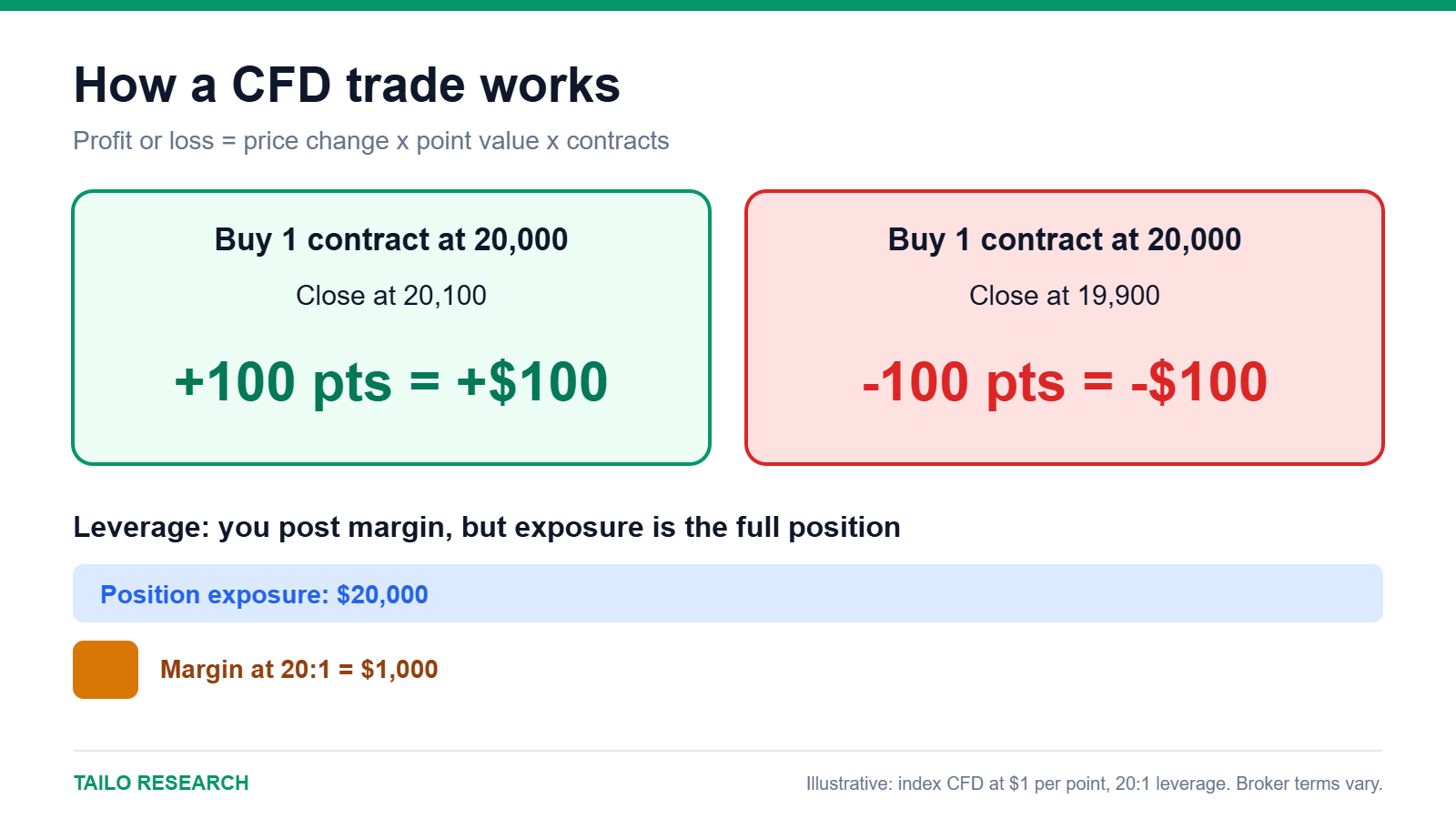
Suppose a broker offers a Nasdaq-100 CFD (often called NAS100) where each index point is worth $1 per contract. You buy one contract at 20,000 and close it at 20,100. You gain 100 points, or $100. If it had fallen to 19,900 instead, you would lose $100. (Illustrative numbers. Contract size and point value differ by broker.)
Leverage and margin
CFDs are leveraged. Instead of paying the full value of the position, you deposit a fraction, called margin. With leverage of 20:1, the $20,000 position in the example above needs about $1,000 of margin. That makes each dollar in your account work harder, but your gains and losses are still calculated on the full position size. A 5% move against you would cost $1,000, which is your entire margin.
If losses eat into your margin, the broker can issue a margin call or automatically close your positions (a stop-out). Regulators in the UK, EU and Australia cap retail leverage, for example at 20:1 on major stock indices. Offshore entities may allow much higher leverage, which raises risk.
What CFDs cost
- Spread: the difference between the buy and sell price. It is the main cost on many accounts.
- Commission: some account types charge a commission per trade with tighter spreads.
- Overnight financing (swap): a charge or credit for holding a position past the daily cutoff.
- Other fees: currency conversion, inactivity or withdrawal fees depending on the broker.
CFDs vs futures vs ETFs vs owning the asset
| CFD | Futures | ETF | Owning the asset | |
|---|---|---|---|---|
| Ownership | No | No | Shares in a fund | Yes |
| Leverage | Yes, set by broker and regulator | Yes, via margin | Not by default | Not by default |
| Counterparty | Your broker | Exchange clearinghouse | Fund and exchange | Depends on custody |
| Expiry | Usually none | Yes | None | None |
| Regulation of the product | Broker-level, varies by entity | Exchange-traded | Exchange-traded | Varies |
For more on the exchange-traded alternatives, see our guides to futures trading, MNQ futures and ETFs.
The risks you need to understand
- Leverage risk: losses can grow quickly, and in some cases exceed your deposit if negative balance protection does not apply to your account.
- Counterparty risk: your broker is on the other side of your contract, so its regulation and financial strength matter.
- Gap risk: prices can jump past your stop, especially around news and economic data releases.
- Costs add up: frequent trading and overnight financing erode returns.
- Access is restricted: CFDs are not available to retail traders in the United States and are limited or banned in some other countries.
Regulators in many countries require brokers to publish the share of retail accounts that lose money on CFDs, and the figures are typically well above half. Treat that as a starting assumption about how hard the product is.
What to check when choosing a CFD broker
- Regulation and legal entity: which regulator supervises the entity that will hold your account?
- Costs: spreads, commissions and financing on the instruments you actually trade.
- Platform and charting: MetaTrader, TradingView-connected trading or the broker’s own platform.
- Negative balance protection and client fund segregation.
- Deposits and withdrawals: methods, speed and fees.
- Terms on bonuses and trading conduct: read the client agreement carefully.
Our Vantage Markets review applies this checklist to one broker.
Risk management basics
Ready to open an account? Our step-by-step guide to opening a Vantage account covers registration, KYC and funding.
- Decide your maximum loss per trade before entering, and use a stop-loss.
- Use lower leverage than the maximum available.
- Size positions from your risk, not from your margin.
- Start on a demo account until you can follow a written plan.
Key takeaways
- A CFD tracks an asset’s price without giving you ownership.
- Leverage magnifies both gains and losses and is the main danger.
- Your broker’s regulation, costs and terms matter as much as the market you trade.
Want to see how CFD trading works on a demo account with TradingView-connected charting? Open a Vantage account. This is an affiliate link: we may earn a commission at no extra charge from us. CFDs are complex instruments and carry a high risk of losing money rapidly due to leverage; most retail accounts lose money. See our Affiliate Disclosure and Risk Disclaimer.
Related reading
Educational content only, not investment advice. Trading and investing involve risk, including the loss of your capital. Read our Risk Disclaimer and Affiliate Disclosure.


Leave a Reply