

The Micro E-mini Nasdaq-100 future, ticker MNQ, is one of the most popular ways to trade the Nasdaq-100 index with small size. It is one-tenth the size of the standard E-mini Nasdaq-100 (NQ), which lets newer traders manage risk in smaller increments while still trading a deeply liquid market.
Here is what you need to know about how MNQ is specified, when it trades, what it costs and how to think about position size.
MNQ contract specifications
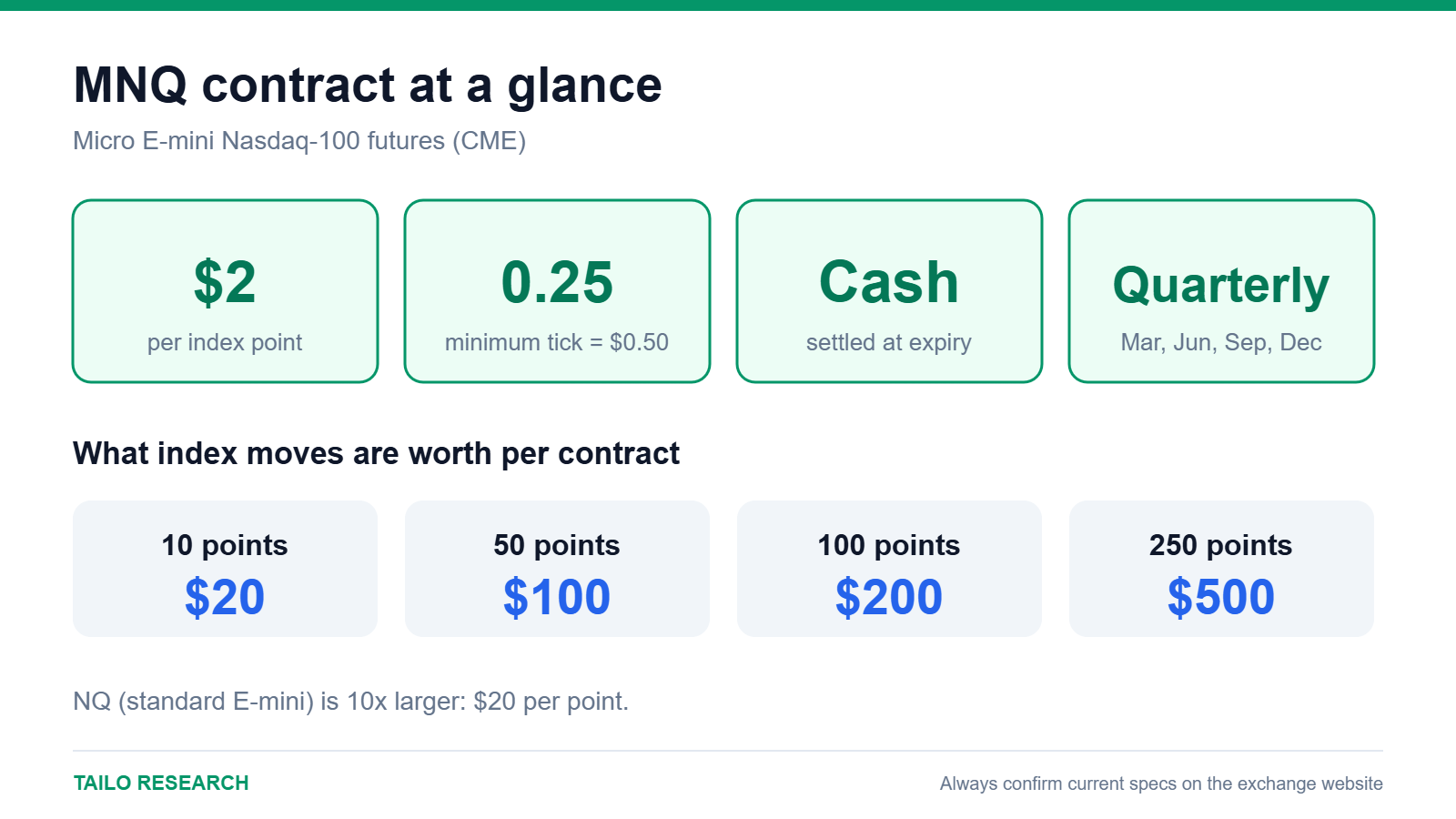
| Item | MNQ (Micro E-mini Nasdaq-100) | NQ (E-mini Nasdaq-100) |
|---|---|---|
| Multiplier | $2 per index point | $20 per index point |
| Minimum tick | 0.25 index points | 0.25 index points |
| Tick value | $0.50 | $5.00 |
| Settlement | Cash-settled | Cash-settled |
| Expiration cycle | March, June, September, December | March, June, September, December |
Because the multiplier is $2, a 10-point move in the index is worth $20 per MNQ contract, and a 100-point move is worth $200. Always confirm current specifications on the exchange website, since contract details can change.
What one contract represents
Notional value equals the index level times the multiplier. If the Nasdaq-100 is at 25,000 (an illustrative level), one MNQ contract represents $50,000 of exposure (25,000 x $2). You only post margin, a fraction of that value, to open the trade, but your profit and loss are calculated on the full $50,000. That is what leverage means in practice.
Trading hours
CME equity index futures trade nearly around the clock from Sunday evening to Friday afternoon (US Eastern Time), with a short daily maintenance break. Liquidity is thickest during the US cash session and around major economic releases, and thinner overnight. Wider spreads and sudden moves are more common when liquidity is low.
Expiration and rolling
MNQ has quarterly contracts. Volume gradually shifts from the expiring contract to the next one in the days before expiry, and most traders roll to the new contract about a week beforehand. Trading an expired or illiquid contract by mistake is a common beginner error, so check which contract month your platform is showing.
Costs to expect
- Commissions and fees: charged per contract per side by your broker, plus exchange and clearing fees.
- Slippage: the difference between the price you expected and the price you got, larger in fast markets.
- Margin: set by the exchange and your broker, and it can change with volatility. Intraday margin is often lower than overnight margin, so check your broker’s rules.
A simple position-sizing example
Suppose you trade a $10,000 account and decide to risk no more than 1% ($100) on any single trade. If your stop-loss is 40 index points away from your entry, each MNQ contract risks 40 x $2 = $80. That means one contract fits the plan; two contracts would risk $160, more than your limit. This is an illustration of the arithmetic, not a recommendation of how much to risk.
The lesson is to start from the amount you are willing to lose, then work out the size, rather than choosing size first and hoping the stop is far enough away.
MNQ vs NQ vs QQQ vs NAS100 CFD
| Instrument | What it is | Key point |
|---|---|---|
| MNQ | Micro futures on the Nasdaq-100 | $2 per point, leverage through margin, expires quarterly |
| NQ | E-mini futures on the Nasdaq-100 | 10x the size of MNQ |
| QQQ | ETF that tracks the Nasdaq-100 | No expiry, no leverage unless you use margin; see our QQQ vs VOO comparison |
| NAS100 CFD | Broker-offered derivative on the index | Contract size, spread and financing are set by your broker |
If you trade the index through a CFD instead of futures, remember that contract size and costs are defined by the broker, not the exchange. Read our CFD guide before you start.
Risk management essentials
- Know your maximum loss in dollars before you click buy or sell.
- Plan around scheduled data. Volatility jumps around CPI, jobs and Fed announcements.
- Use levels rather than guesses to place stops. Our support and resistance guide shows how.
- Keep size small until you have a written, tested plan.
Key takeaways
- MNQ is a $2-per-point, cash-settled contract that is one-tenth the size of NQ.
- Notional exposure is far larger than your margin, so size positions from risk, not from margin.
- Check contract month, hours and fees before your first trade.
Want to trade the Nasdaq-100 as a CFD instead of a futures contract, with charts on TradingView? Open a Vantage account. This is an affiliate link: we may earn a commission at no extra charge from us. CFDs are complex instruments and carry a high risk of losing money rapidly due to leverage; most retail accounts lose money. See our Affiliate Disclosure and Risk Disclaimer.
Related reading
Educational content only, not investment advice. Trading and investing involve risk, including the loss of your capital. Read our Risk Disclaimer and Affiliate Disclosure.


Leave a Reply