

Bitcoin is the first and largest cryptocurrency, and it has grown from an experiment into an asset class that funds, companies and everyday traders follow closely. It is also one of the most volatile markets you can trade. This guide explains what Bitcoin is, how it works, what moves its price and the main ways people get exposure to it.
What is Bitcoin?
Bitcoin is a decentralized digital currency that runs on a public ledger called the blockchain. It was launched in 2009 by a person or group using the name Satoshi Nakamoto. No bank or government controls it. Instead, a global network of computers verifies transactions and records them in blocks about every ten minutes.
Bitcoin’s supply is capped at 21 million coins. That fixed limit is a core part of its appeal to supporters, who compare it to a digital form of scarce assets like gold.
How Bitcoin works in simple terms
- Wallets and keys: you hold Bitcoin through a wallet secured by a private key. Whoever controls the key controls the coins.
- Transactions: when you send Bitcoin, the network checks that you own it and adds the transfer to the blockchain.
- Mining: miners use computing power to secure the network and add new blocks, and they earn newly created Bitcoin and fees in return.
- Halving: roughly every four years, or every 210,000 blocks, the reward for mining a block is cut in half. The most recent halving took place in April 2024.
What moves the price of Bitcoin
- Adoption and demand: more buyers, including institutions, tend to push price up.
- ETF and fund flows: spot Bitcoin ETFs launched in the United States in January 2024 and gave investors a regulated way to hold exposure.
- Liquidity and interest rates: looser financial conditions have generally supported risk assets, including crypto. See how economic data moves markets.
- Supply events: halvings reduce new supply growth, which many traders watch.
- Sentiment and news: regulation, exchange failures and market panics can trigger large swings.
Bitcoin can move fast in both directions. In the 2022 bear market it fell more than 70% from its all-time high at the time. Plan for volatility before you buy.
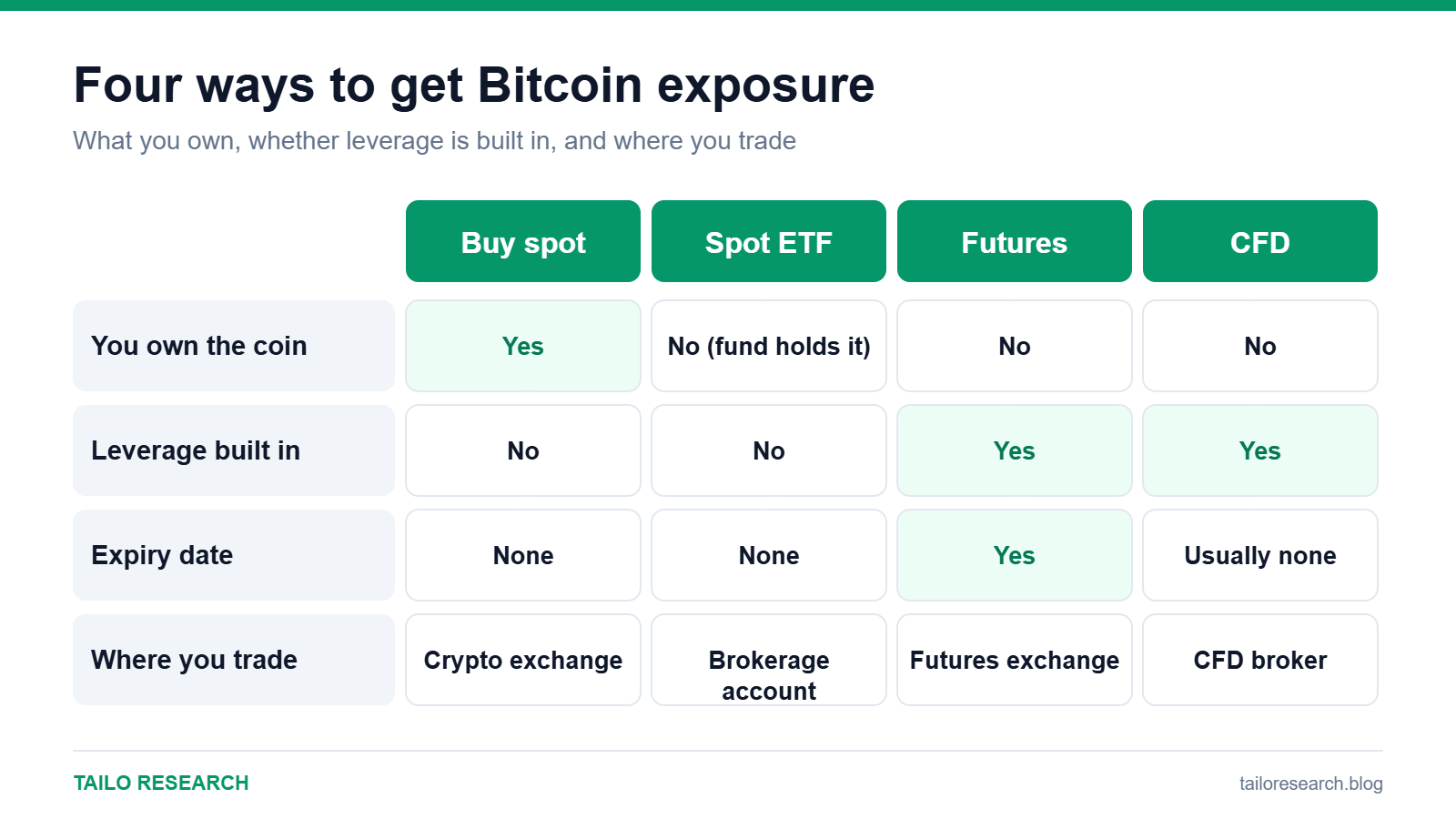
Ways to get exposure to Bitcoin
| Method | What you get | Things to know |
|---|---|---|
| Buy on a crypto exchange | You own actual Bitcoin | You choose custody: leave it with the exchange or move it to your own wallet |
| Spot Bitcoin ETF | Shares in a fund that holds Bitcoin | Trades in a normal brokerage account during market hours; see how ETFs work |
| Futures | A contract on Bitcoin’s price | Leverage and expiry; see futures trading for beginners |
| CFDs | A derivative that tracks the price | No ownership, leverage and financing costs; see what is CFD trading? |
Safety basics
- Use reputable, regulated exchanges and turn on two-factor authentication.
- Never share your seed phrase or private key with anyone, including people claiming to be support staff.
- Be suspicious of guaranteed returns, giveaways and urgent messages. Scams are common in crypto.
- If you self-custody, back up your seed phrase offline and test with a small amount first.
- Keep records of your trades, since many countries tax crypto gains.
Key risks
- Volatility: large price swings are normal.
- Regulation: rules differ by country and can change.
- Custody: losing keys or using a failing platform can mean losing your coins.
- Leverage: futures and CFDs magnify losses.
Key takeaways
- Bitcoin is a scarce, decentralized digital asset with a fixed 21 million supply.
- You can get exposure through spot ownership, ETFs, futures or CFDs, and each carries different risks.
- Volatility and custody are the biggest practical challenges for beginners.
Related reading
Educational content only, not investment advice. Trading and investing involve risk, including the loss of your capital. Read our Risk Disclaimer and Affiliate Disclosure.


Leave a Reply