

No single data point reliably predicts a recession on its own, which is why economists and traders watch a basket of indicators together. This guide covers the most closely followed ones.
Key indicators economists track
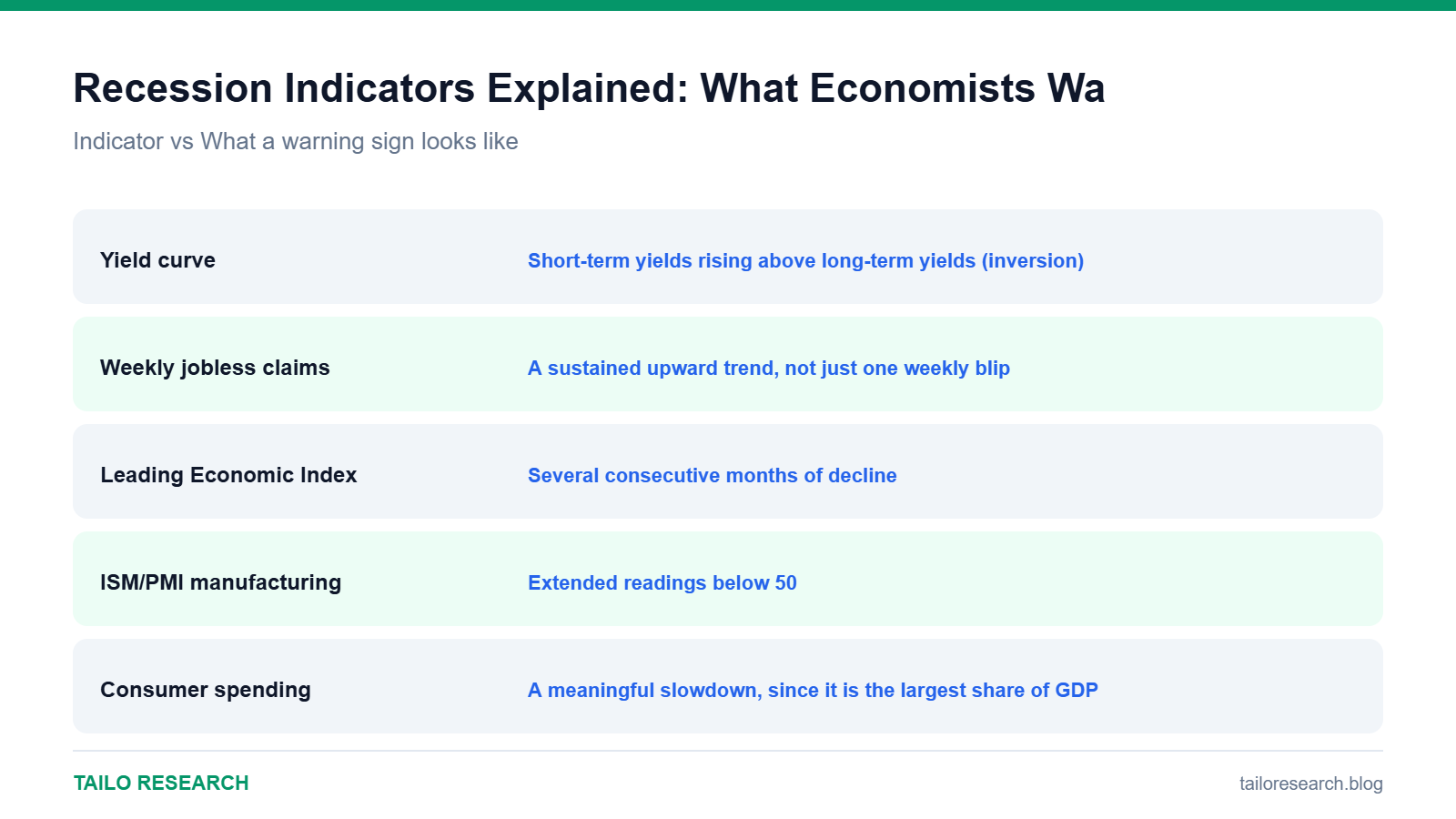
| Indicator | What a warning sign looks like |
|---|---|
| Yield curve | Short-term yields rising above long-term yields (inversion) |
| Weekly jobless claims | A sustained upward trend, not just one weekly blip |
| Leading Economic Index | Several consecutive months of decline |
| ISM/PMI manufacturing | Extended readings below 50 |
| Consumer spending | A meaningful slowdown, since it is the largest share of GDP |
Why no single indicator is definitive
Each of these indicators has produced false signals in the past: yield curve inversions that were not followed by recession, or PMI dips that reversed without a broader downturn. Economists generally look for confirmation across multiple indicators moving in the same direction, not a single trigger.
The official recession-dating process
In the US, recessions are formally dated by the National Bureau of Economic Research (NBER), which looks at a broad range of data, including employment, income, spending and production, often well after a recession has already started or ended.
A practical takeaway
Rather than waiting for an official recession call, many investors watch this basket of leading indicators together to gauge rising or falling risk over time, treating any single reading as one data point among many.
Key takeaways
- No single indicator reliably predicts recessions on its own; watch several together.
- The yield curve, jobless claims and PMI are among the most closely followed leading indicators.
- Official recession dating (NBER in the US) often happens well after a recession has already begun.
Want to trade what you read here as a CFD alongside TradingView charts? Open a Vantage account. This is an affiliate link: we may earn a commission at no extra charge from us. CFDs are complex instruments and carry a high risk of losing money rapidly due to leverage; most retail accounts lose money.
Educational content only, not investment advice. Trading and investing involve risk, including the loss of your capital. Read our Risk Disclaimer and Affiliate Disclosure.


Leave a Reply