

The Dow, S&P 500 and Nasdaq are the three indices most often quoted in financial news, but they are built very differently, which explains why they sometimes move in different directions on the same day.
How each index is built
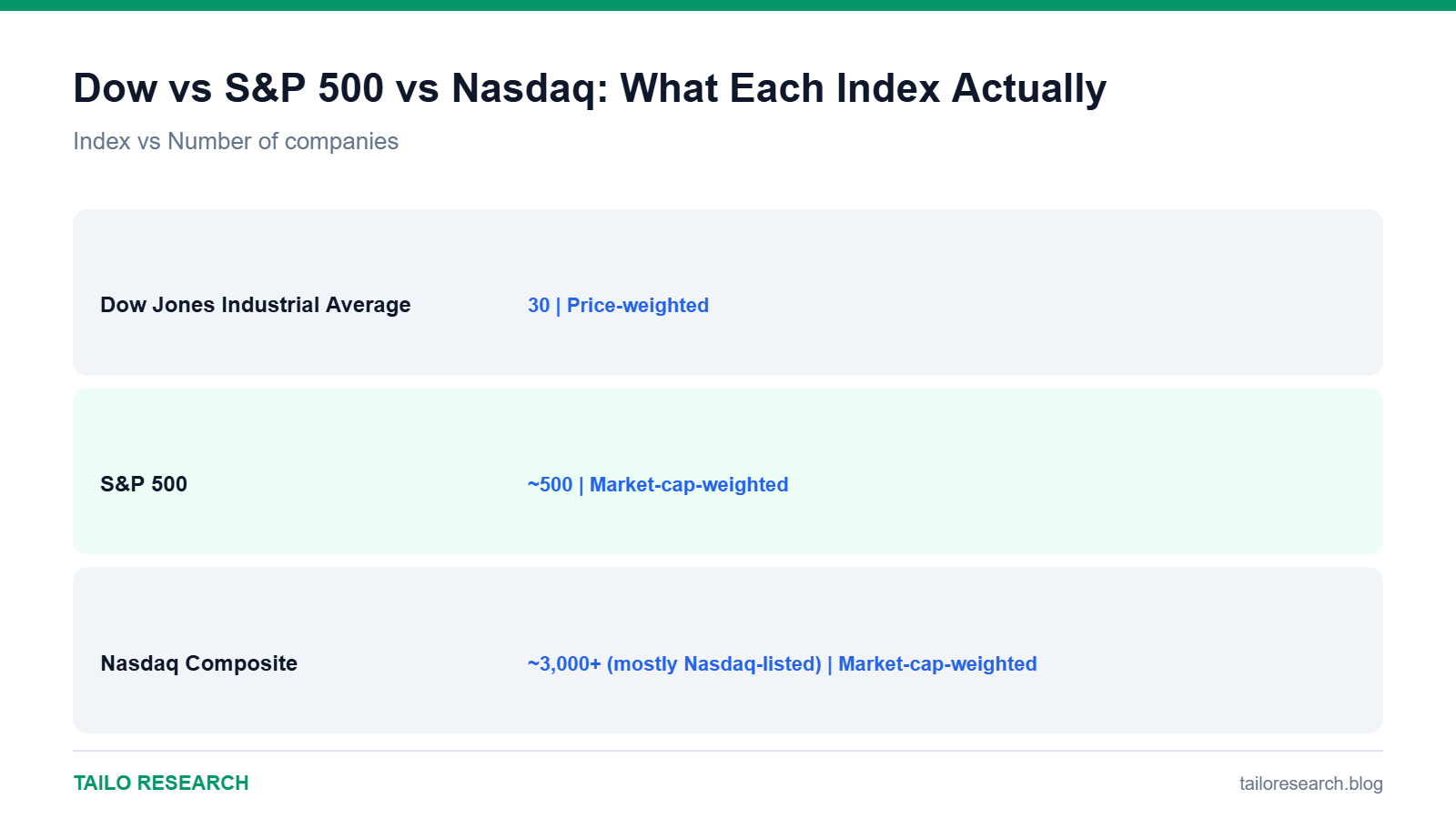
| Index | Number of companies | Weighting method | Sector tilt |
|---|---|---|---|
| Dow Jones Industrial Average | 30 | Price-weighted | Broad, but heavily influenced by high-priced stocks |
| S&P 500 | ~500 | Market-cap-weighted | Broad, diversified across all major sectors |
| Nasdaq Composite | ~3,000+ (mostly Nasdaq-listed) | Market-cap-weighted | Heavily tilted toward technology |
Why price-weighting makes the Dow unusual
The Dow is price-weighted, meaning a $500 stock influences the index roughly ten times more than a $50 stock, regardless of the actual size (market cap) of either company. This is an older, less common methodology than the market-cap weighting used by the S&P 500 and Nasdaq.
Why they can diverge on the same day
Because the Nasdaq Composite is technology-heavy, a strong or weak day for a handful of mega-cap tech stocks can move it far more than the broader, more diversified S&P 500 or the differently-weighted Dow, even when the day’s broader economic news is the same for all three.
Which one to actually watch
The S&P 500 is generally considered the most representative single gauge of the overall US stock market, given its size and market-cap weighting. The Nasdaq is more useful specifically for gauging technology and growth-stock sentiment; the Dow is followed mainly for its long historical track record and media familiarity.
Key takeaways
- The Dow is price-weighted; the S&P 500 and Nasdaq are market-cap-weighted.
- The Nasdaq Composite is heavily tilted toward technology, unlike the broader S&P 500.
- The S&P 500 is generally considered the most representative gauge of the overall US market.
Want to trade what you read here as a CFD alongside TradingView charts? Open a Vantage account. This is an affiliate link: we may earn a commission at no extra charge from us. CFDs are complex instruments and carry a high risk of losing money rapidly due to leverage; most retail accounts lose money.
Educational content only, not investment advice. Trading and investing involve risk, including the loss of your capital. Read our Risk Disclaimer and Affiliate Disclosure.


Leave a Reply