

Gross domestic product (GDP) is the broadest single measure of economic activity, and its quarterly release moves markets. This guide explains what it captures and how to read the headline number.
What GDP measures
GDP measures the total value of goods and services produced within a country over a specific period. In the US, it is typically reported as an annualized quarterly growth rate, meaning the quarter’s growth rate as if it continued for a full year.
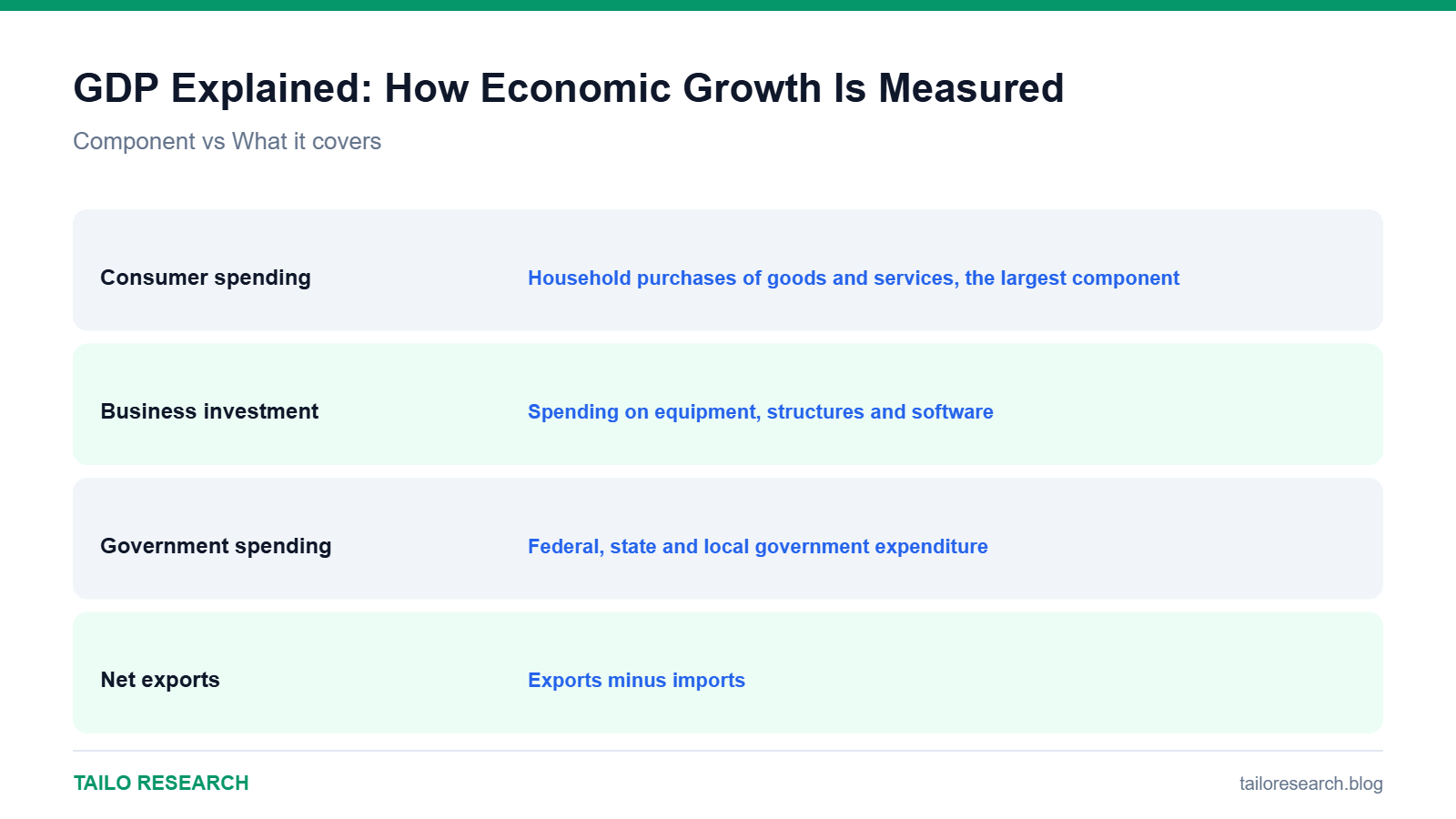
The four components of GDP
| Component | What it covers |
|---|---|
| Consumer spending | Household purchases of goods and services, the largest component |
| Business investment | Spending on equipment, structures and software |
| Government spending | Federal, state and local government expenditure |
| Net exports | Exports minus imports |
Why markets react to GDP
GDP is a lagging, backward-looking indicator (it reports on a quarter that has already ended), but it confirms or contradicts the narrative built from faster, more frequent data like jobs reports and PMI surveys. A surprise relative to expectations, not the absolute number, tends to drive the market reaction.
Advance, preliminary and final estimates
The US reports GDP for each quarter in three stages, advance, second and third (final) estimates, as more complete data becomes available. Revisions between estimates can be meaningful and occasionally shift the overall growth narrative.
Key takeaways
- GDP measures total economic output, reported as an annualized quarterly growth rate in the US.
- Consumer spending is typically the largest component of GDP.
- GDP is backward-looking; markets react more to the surprise versus expectations than the absolute number.
Want to trade what you read here as a CFD alongside TradingView charts? Open a Vantage account. This is an affiliate link: we may earn a commission at no extra charge from us. CFDs are complex instruments and carry a high risk of losing money rapidly due to leverage; most retail accounts lose money.
Educational content only, not investment advice. Trading and investing involve risk, including the loss of your capital. Read our Risk Disclaimer and Affiliate Disclosure.


Leave a Reply