

VWAP, the volume-weighted average price, is one of the most closely watched intraday indicators among institutional traders, since it reflects the average price paid across all trading volume, not just price alone.
What VWAP measures
VWAP calculates the average price of a security throughout the trading day, weighted by volume at each price level, rather than a simple average of price alone. It typically resets each trading session.
Why institutions watch VWAP closely
Large institutional orders are often measured against VWAP as a benchmark: an institution buying below VWAP or selling above it is considered to have executed favorably relative to the day’s overall trading activity. This makes VWAP a genuine reference point for a large share of real trading activity, not just a technical indicator.
How retail traders use VWAP
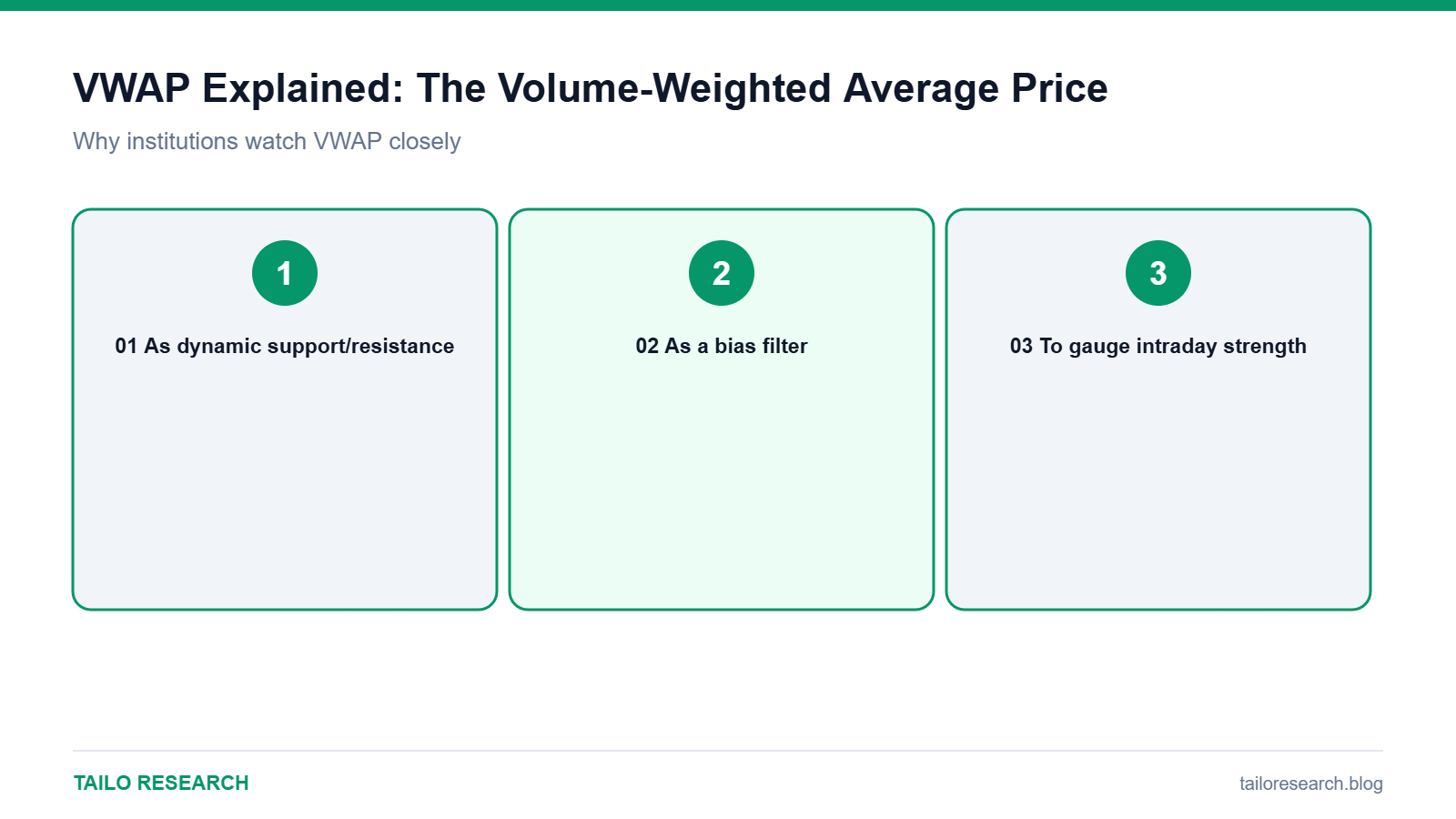
- As dynamic support/resistance: price often reacts around VWAP during the trading day
- As a bias filter: some traders only look for long setups when price is above VWAP, and short setups when below
- To gauge intraday strength: persistent trading above VWAP suggests buyers are in control for the session, and vice versa
Limitations
VWAP resets daily and is most useful on intraday timeframes; it has little relevance for multi-day swing or position trades. It also becomes less meaningful in the first few minutes of a session, before enough volume has accumulated.
Key takeaways
- VWAP is the volume-weighted average price for the current trading session.
- Institutional traders use it as an execution benchmark, giving it real market significance.
- It is an intraday tool and resets daily, with limited relevance for multi-day trades.
Want to trade what you read here as a CFD alongside TradingView charts? Open a Vantage account. This is an affiliate link: we may earn a commission at no extra charge from us. CFDs are complex instruments and carry a high risk of losing money rapidly due to leverage; most retail accounts lose money.
Educational content only, not investment advice. Trading and investing involve risk, including the loss of your capital. Read our Risk Disclaimer and Affiliate Disclosure.


Leave a Reply