

A demo account lets you trade with real-time market prices and no financial risk, using simulated funds. Vantage offers a free demo account across its platforms. Here is how it works and why most experienced traders recommend starting there.
What a demo account actually simulates
A Vantage demo account mirrors live market pricing and execution conditions as closely as possible, letting you place trades, set stop-losses and take-profits, and watch positions move in real time, all with virtual funds instead of real money. It is the closest thing to live trading without financial risk.
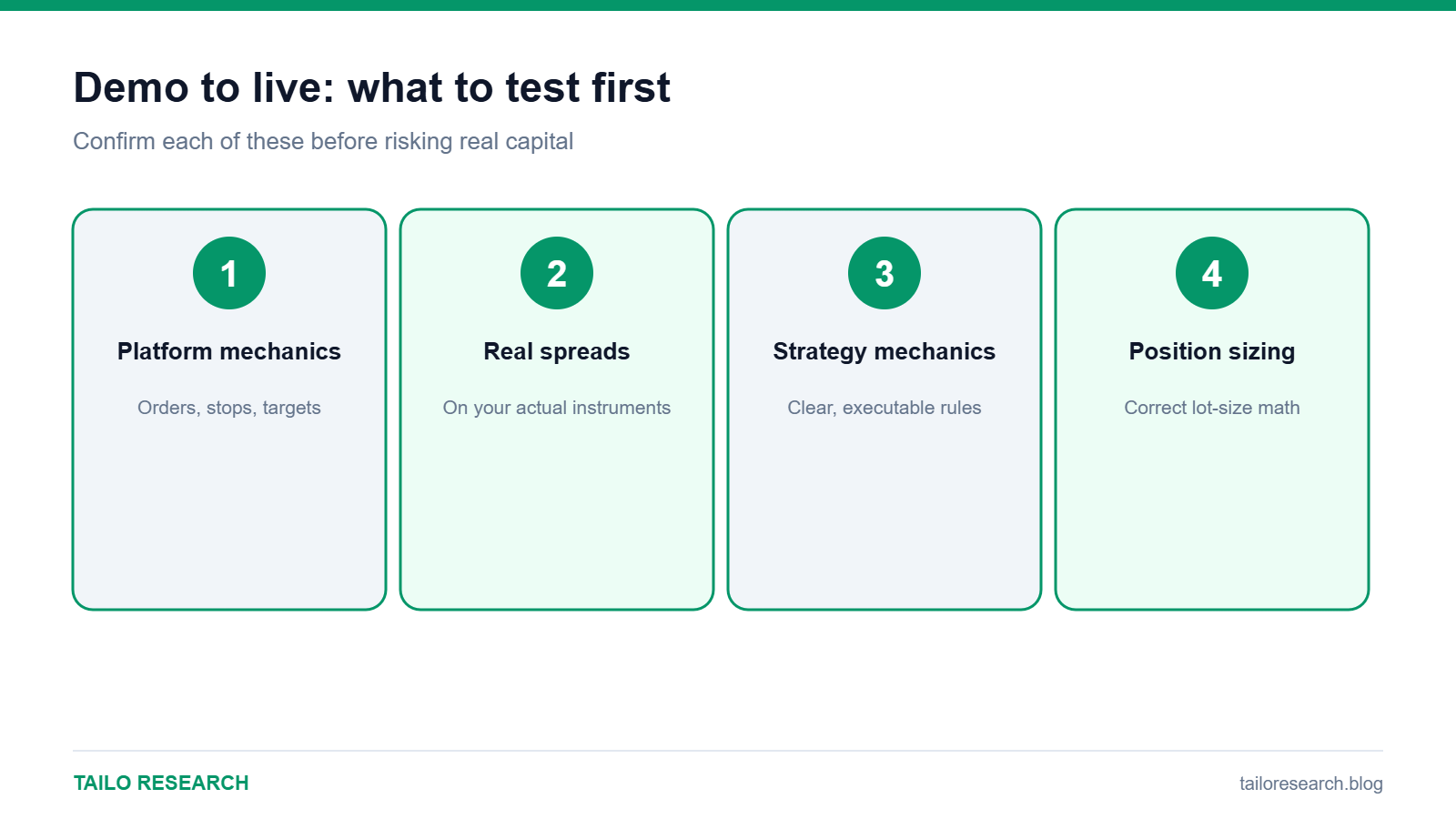
What to actually test on a demo account
- Platform mechanics: placing, modifying and closing orders on MT4, MT5 or ProTrader before you need to do it under pressure
- Real spreads: check live spreads on the specific instruments you plan to trade, since these vary by account type and market conditions
- Your strategy’s mechanics: whether your entry, stop and target rules are clear and executable in practice, not just on paper
- Position sizing math: confirm you can correctly calculate lot size from your risk tolerance and stop distance before risking real capital
What a demo account cannot simulate
Demo trading removes the emotional pressure of real money, which is exactly why many traders who look profitable on demo struggle when they switch to live trading. A demo account is useful for confirming your mechanics and platform fluency, not for proving that a strategy will hold up psychologically under live conditions. Treat strong demo results as a minimum bar to clear, not a guarantee of live performance.
How long to demo trade before going live
There is no fixed rule, but a reasonable minimum is enough trades to see your strategy play out across different market conditions — trending, ranging and volatile — rather than just a lucky short stretch. Many traders demo trade for several weeks, tracking results in a journal, before committing real capital.
Switching from demo to live
- Complete KYC verification in advance so it does not delay your first live withdrawal later
- Fund your live account with an amount you are fully prepared to lose
- Start with smaller position sizes than you used on demo, since live execution and psychology differ from simulated trading
- Keep using the same trade journal habits you built during the demo phase
Key takeaways
- A demo account mirrors live pricing and execution with simulated funds, at no financial risk.
- Use it to test platform mechanics, real spreads and position sizing, not to prove a strategy psychologically.
- Start live trading with smaller size than you used on demo.
Ready to open an account? Open a Vantage account. This is an affiliate link: we may earn a commission at no extra charge from us. CFDs are complex instruments and carry a high risk of losing money rapidly due to leverage; most retail accounts lose money.
Educational content only, not investment advice. Trading and investing involve risk, including the loss of your capital. Read our Risk Disclaimer and Affiliate Disclosure.


Leave a Reply