

Many new traders focus entirely on how often they win, but risk-reward ratio, how much you stand to gain versus how much you risk, matters just as much, if not more. This guide explains why.
What risk-reward ratio measures
Risk-reward ratio compares your potential loss (distance from entry to stop) against your potential gain (distance from entry to target). A trade risking $100 to make $200 has a 1:2 risk-reward ratio.
Why win rate alone is misleading
A strategy that wins 40% of the time can still be highly profitable if winners are, on average, meaningfully larger than losers. Conversely, a strategy that wins 70% of the time can lose money overall if the rare losses are disproportionately large.
A simple example
| Scenario | Win rate | Avg risk-reward | Outcome over 10 trades |
|---|---|---|---|
| A | 40% | 1:3 | 4 wins x $300 – 6 losses x $100 = +$600 |
| B | 70% | 1:0.5 | 7 wins x $50 – 3 losses x $100 = +$50 |
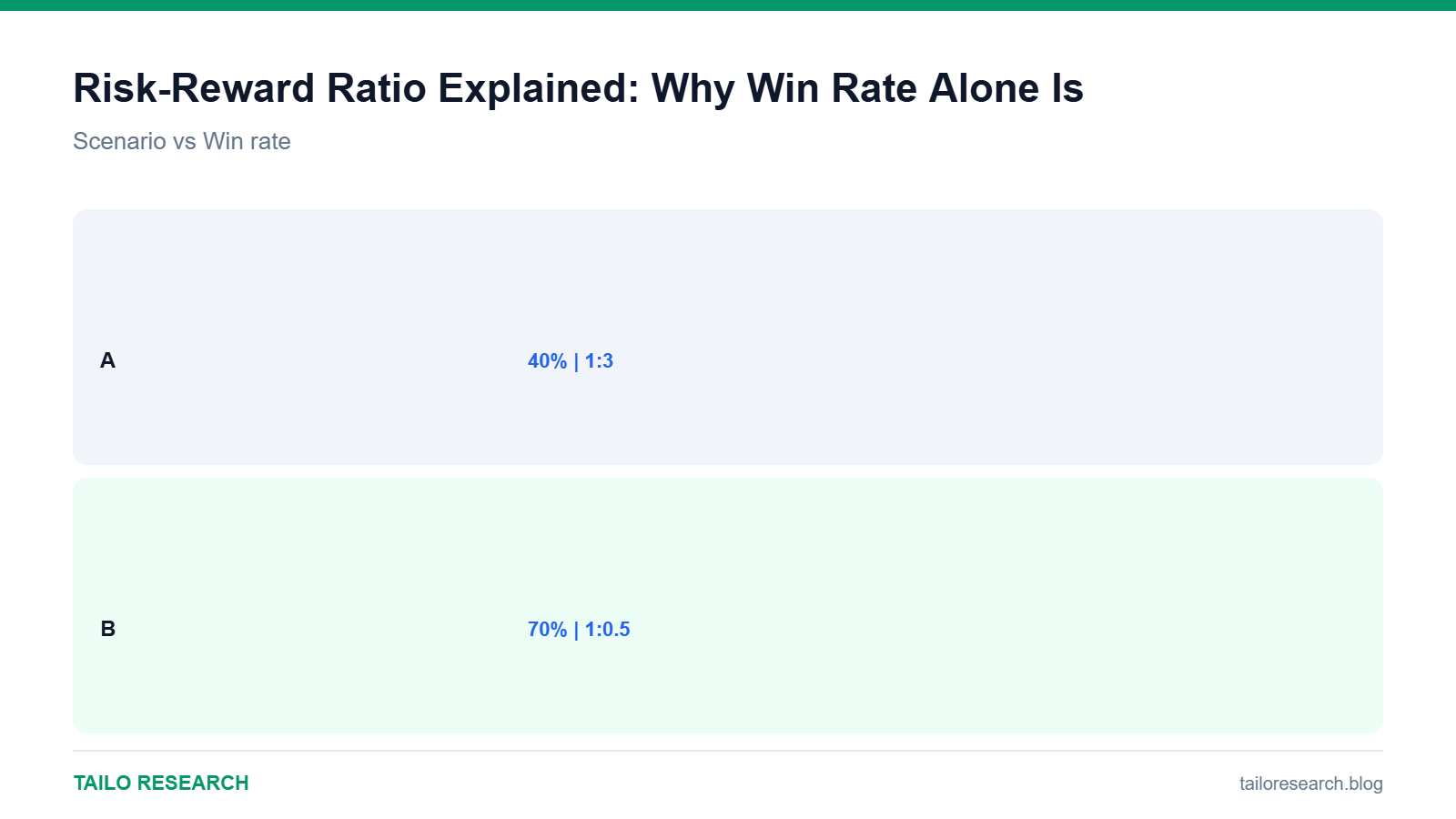
Both scenarios are illustrative, not a guarantee of real trading results, but they show why risk-reward and win rate must be considered together, not separately.
Setting a minimum risk-reward threshold
Many traders set a minimum acceptable risk-reward ratio, commonly 1:2 or better, before taking a trade at all, as a filter that removes setups where even a decent win rate would struggle to be profitable after costs.
Key takeaways
- Risk-reward ratio compares potential loss against potential gain on a trade.
- A lower win rate can still be profitable with a strong average risk-reward ratio, and vice versa.
- Setting a minimum risk-reward threshold before entering a trade is a common risk-management filter.
Want to trade what you read here as a CFD alongside TradingView charts? Open a Vantage account. This is an affiliate link: we may earn a commission at no extra charge from us. CFDs are complex instruments and carry a high risk of losing money rapidly due to leverage; most retail accounts lose money.
Educational content only, not investment advice. Trading and investing involve risk, including the loss of your capital. Read our Risk Disclaimer and Affiliate Disclosure.


Leave a Reply