

Choosing the right order type affects the price you actually get and how much control you have over execution. This guide covers the four most common order types.
The four core order types
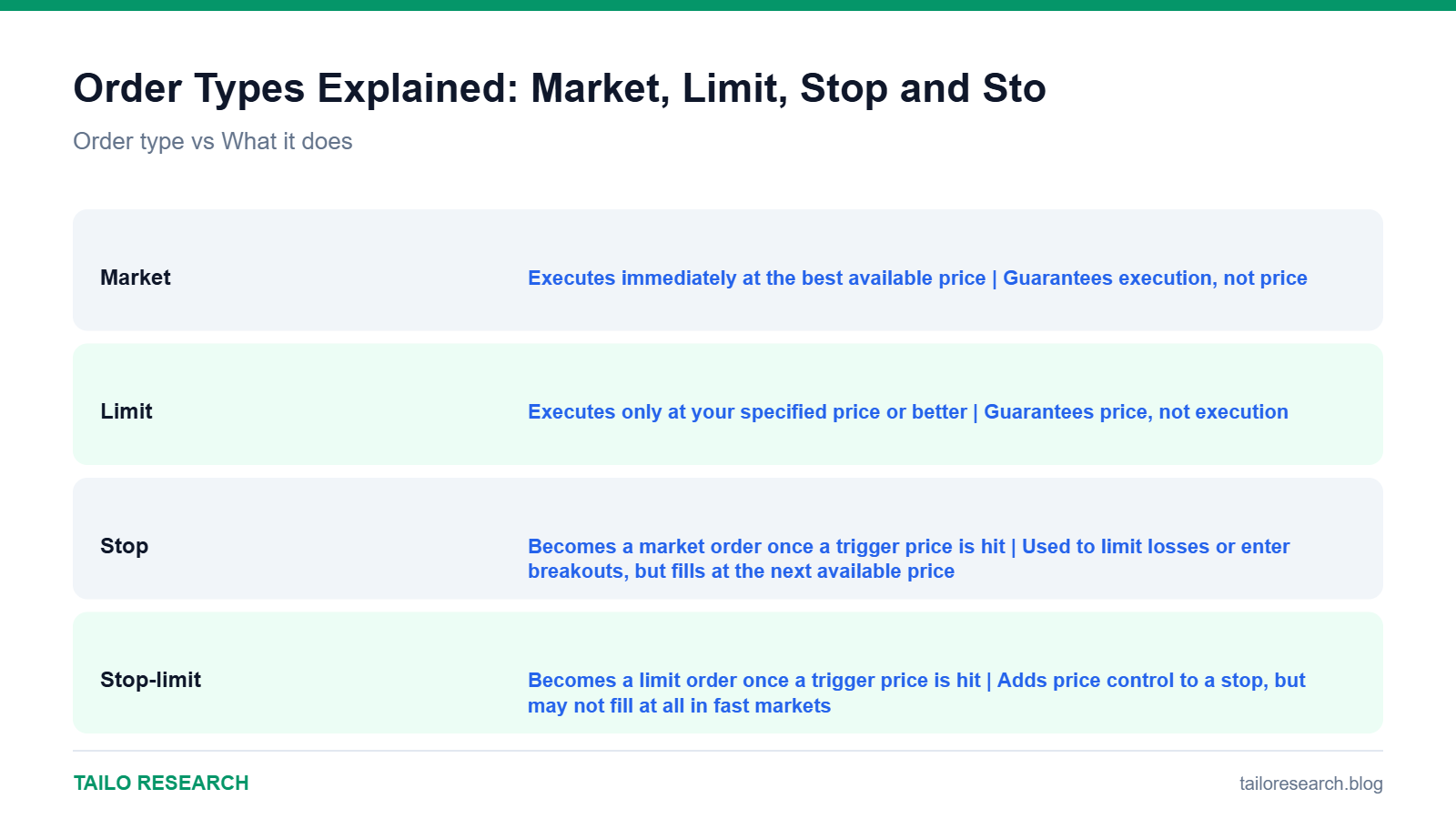
| Order type | What it does | Trade-off |
|---|---|---|
| Market | Executes immediately at the best available price | Guarantees execution, not price |
| Limit | Executes only at your specified price or better | Guarantees price, not execution |
| Stop | Becomes a market order once a trigger price is hit | Used to limit losses or enter breakouts, but fills at the next available price |
| Stop-limit | Becomes a limit order once a trigger price is hit | Adds price control to a stop, but may not fill at all in fast markets |
When to use each
- Market order: when speed matters more than exact price, in a liquid market
- Limit order: when you want price certainty and are willing to risk not getting filled
- Stop order: most commonly used as a stop-loss, to exit automatically if a trade goes against you
- Stop-limit order: when you want a stop-loss but also want to avoid an unfavorable fill during a sudden gap
A risk worth understanding: stop order slippage
A stop order guarantees that an order will be triggered, but not the price it fills at. In a fast-moving or gapping market, a stop order can fill significantly worse than the trigger price, which is why some traders use stop-limit orders instead, accepting the risk of no fill at all in exchange for price control.
Key takeaways
- Market orders guarantee execution; limit orders guarantee price, not execution.
- Stop orders trigger a market order; stop-limit orders trigger a limit order.
- Stop orders can suffer slippage in fast markets, a trade-off stop-limit orders address differently.
Want to trade what you read here as a CFD alongside TradingView charts? Open a Vantage account. This is an affiliate link: we may earn a commission at no extra charge from us. CFDs are complex instruments and carry a high risk of losing money rapidly due to leverage; most retail accounts lose money.
Educational content only, not investment advice. Trading and investing involve risk, including the loss of your capital. Read our Risk Disclaimer and Affiliate Disclosure.


Leave a Reply