

Most trading losses trace back to a small set of repeated, well-documented mistakes rather than bad luck alone. This guide covers the most common ones and how to address each.
The most common mistakes
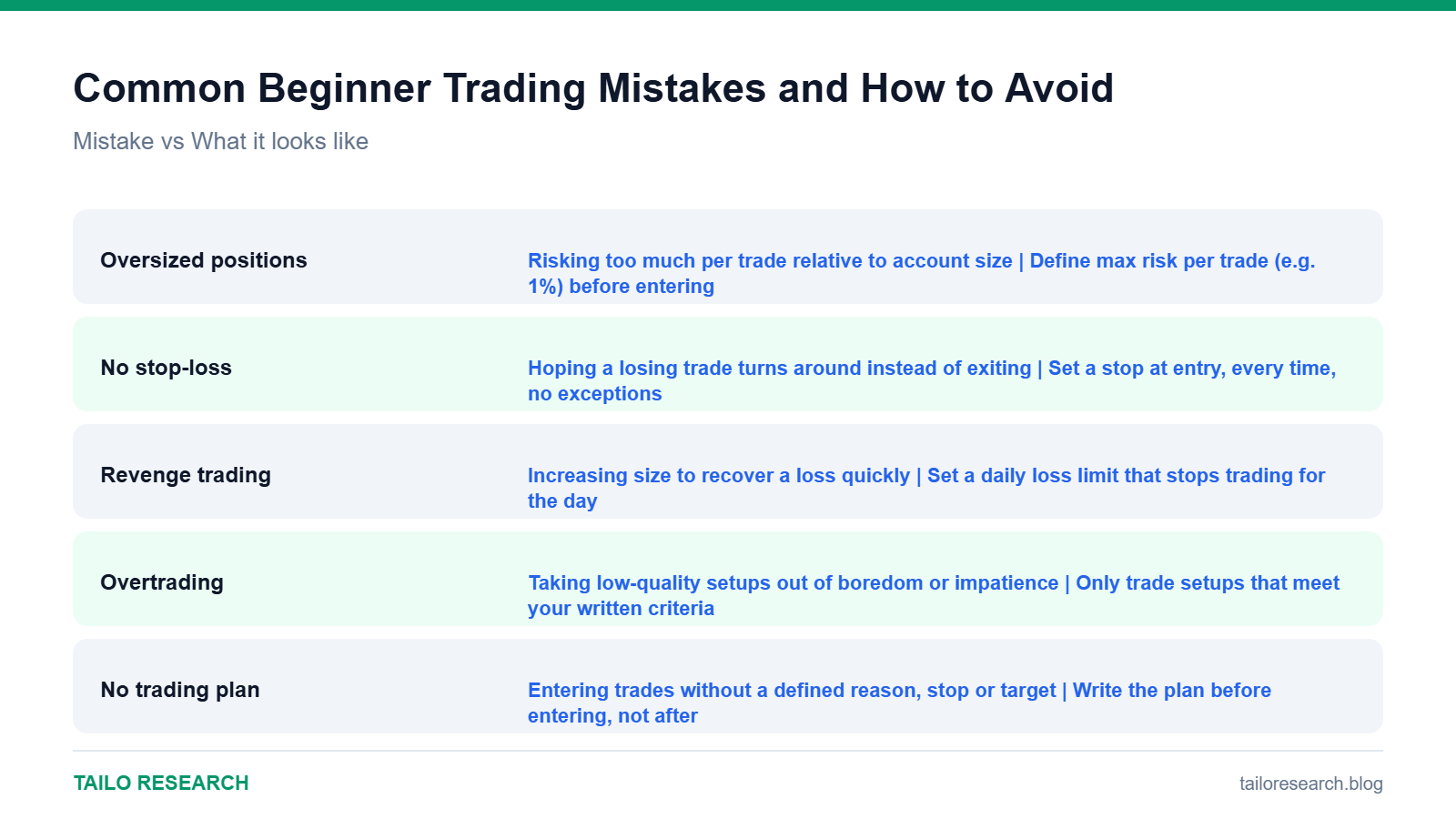
| Mistake | What it looks like | How to address it |
|---|---|---|
| Oversized positions | Risking too much per trade relative to account size | Define max risk per trade (e.g. 1%) before entering |
| No stop-loss | Hoping a losing trade turns around instead of exiting | Set a stop at entry, every time, no exceptions |
| Revenge trading | Increasing size to recover a loss quickly | Set a daily loss limit that stops trading for the day |
| Overtrading | Taking low-quality setups out of boredom or impatience | Only trade setups that meet your written criteria |
| No trading plan | Entering trades without a defined reason, stop or target | Write the plan before entering, not after |
Why these mistakes are so common
Most of these mistakes are driven by emotion under pressure, not lack of knowledge. Traders who can explain proper risk management in theory often abandon it in the moment, particularly after a loss or a missed opportunity.
A practical starting checklist
- Define your maximum risk per trade and per day before you start trading live
- Use a stop-loss on every position, set at entry
- Keep a trading journal to catch repeated patterns
- Trade smaller size than feels comfortable until your discipline is proven over many trades
Key takeaways
- Most beginner losses trace back to a handful of repeated, well-known mistakes.
- Oversized positions, missing stops and revenge trading are the most common.
- Defining rules in advance, and following them under pressure, matters more than strategy complexity.
Want to trade what you read here as a CFD alongside TradingView charts? Open a Vantage account. This is an affiliate link: we may earn a commission at no extra charge from us. CFDs are complex instruments and carry a high risk of losing money rapidly due to leverage; most retail accounts lose money.
Educational content only, not investment advice. Trading and investing involve risk, including the loss of your capital. Read our Risk Disclaimer and Affiliate Disclosure.


Leave a Reply