

Decentralized finance, or DeFi, refers to financial applications built on blockchains like Ethereum that operate without a traditional intermediary such as a bank or broker. This guide covers the basics and the risks.
What DeFi applications actually do
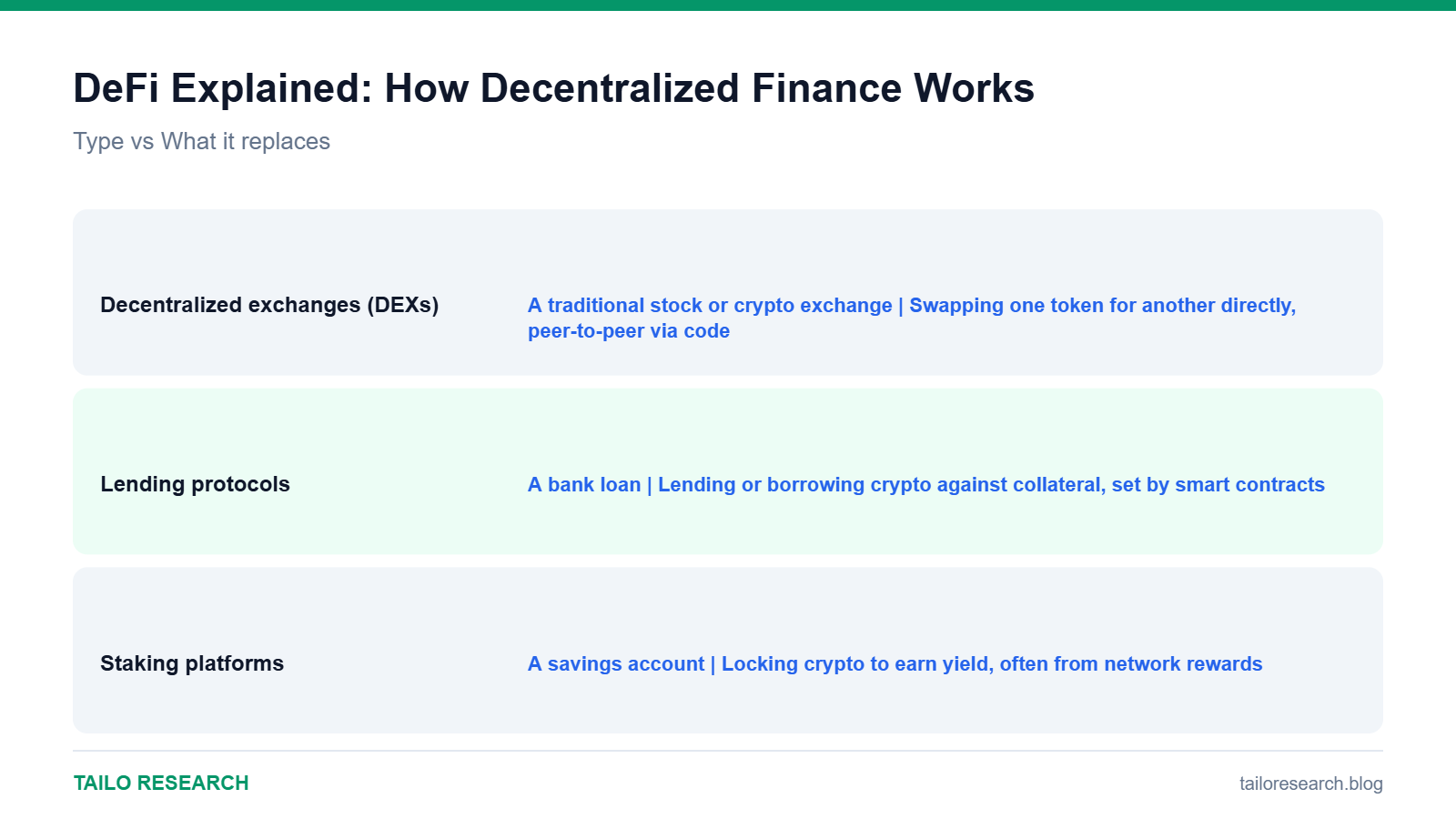
| Type | What it replaces | Example function |
|---|---|---|
| Decentralized exchanges (DEXs) | A traditional stock or crypto exchange | Swapping one token for another directly, peer-to-peer via code |
| Lending protocols | A bank loan | Lending or borrowing crypto against collateral, set by smart contracts |
| Staking platforms | A savings account | Locking crypto to earn yield, often from network rewards |
How DeFi removes the intermediary
Instead of a company processing your trade or loan, DeFi applications use smart contracts, self-executing code on a blockchain, to handle the transaction automatically according to pre-set rules. No central party holds your funds in the traditional sense.
Risks specific to DeFi
- Smart contract risk: bugs or exploits in the underlying code can result in permanent loss of funds
- No customer support: there is typically no company to call if something goes wrong
- Impermanent loss: providing liquidity to a DEX can result in a loss relative to simply holding the assets, depending on price movements
- Regulatory uncertainty: DeFi’s legal status is still evolving in most countries
Key takeaways
- DeFi applications use smart contracts to replace traditional financial intermediaries.
- Removing the intermediary also removes traditional safety nets like customer support and deposit insurance.
- Smart contract risk and impermanent loss are risks specific to DeFi that traditional finance does not carry.
Want to trade what you read here as a CFD alongside TradingView charts? Open a Vantage account. This is an affiliate link: we may earn a commission at no extra charge from us. CFDs are complex instruments and carry a high risk of losing money rapidly due to leverage; most retail accounts lose money.
Educational content only, not investment advice. Trading and investing involve risk, including the loss of your capital. Read our Risk Disclaimer and Affiliate Disclosure.


Leave a Reply