

The Average True Range (ATR) is a technical indicator that measures volatility rather than direction, making it a popular tool for setting stops and position sizes that adapt to current market conditions.
What ATR measures
ATR calculates the average of the true range (the greatest of: current high minus low, high minus prior close, or low minus prior close) over a set number of periods, commonly 14. It answers the question: how much does this instrument typically move in a given period?
What ATR does not tell you
ATR says nothing about direction. A rising ATR means the market is becoming more volatile, but not whether that volatility is bullish or bearish. It is a volatility gauge, not a trend or momentum indicator.
How traders use ATR
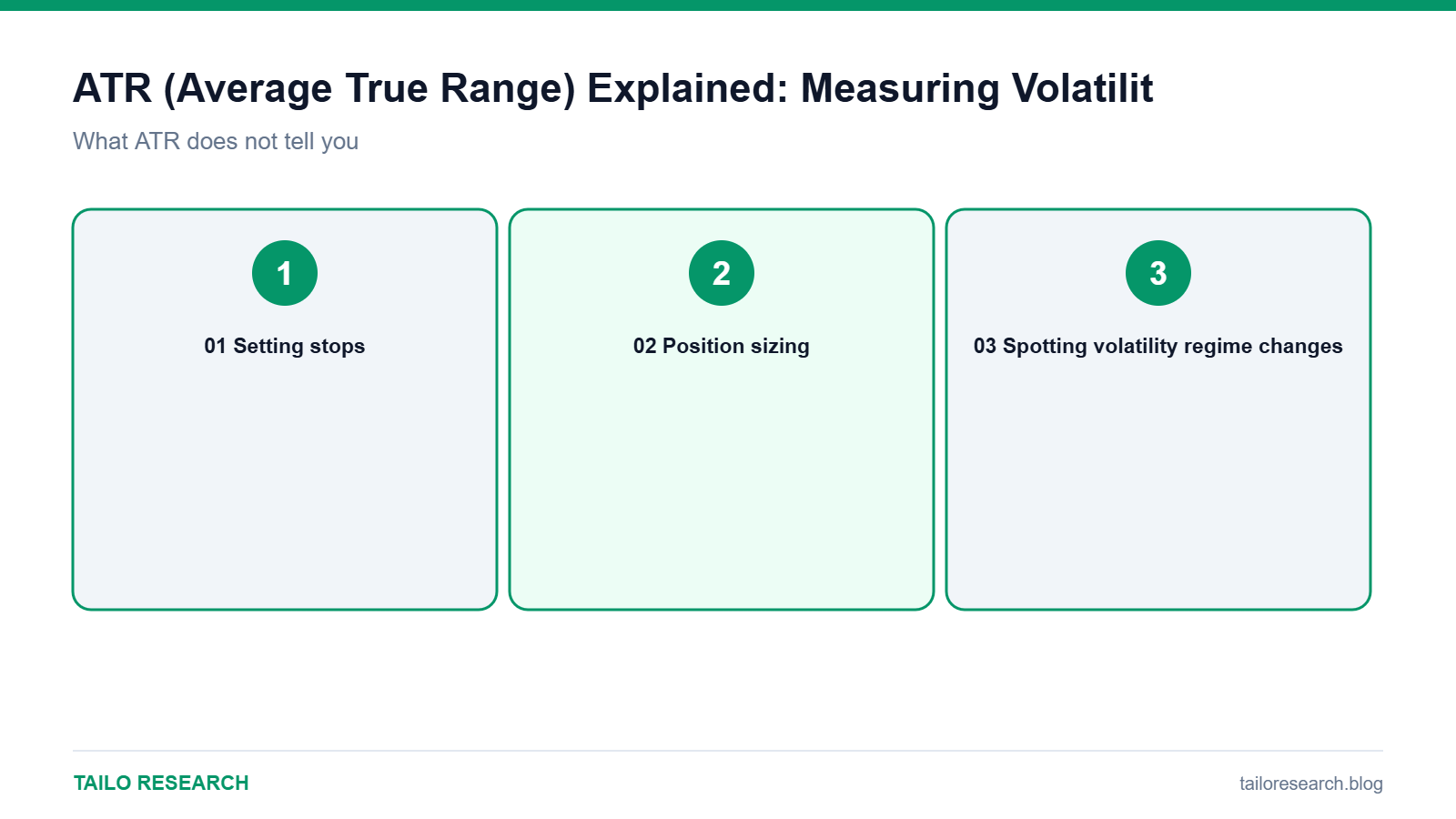
- Setting stops: placing a stop a multiple of ATR away from entry, so it adapts to current volatility instead of using a fixed point distance
- Position sizing: a wider ATR means a wider stop is often needed, so position size shrinks accordingly to keep dollar risk consistent
- Spotting volatility regime changes: a sharp rise in ATR can signal a market entering a more volatile, news-driven phase
A simple example
If a stock’s 14-day ATR is $2, a trader might place a stop 2x ATR ($4) below entry, rather than an arbitrary fixed dollar amount, so the stop naturally widens in more volatile markets and tightens in calmer ones.
Key takeaways
- ATR measures typical volatility, not direction.
- It is commonly used to set stops and position sizes that adapt to current conditions.
- A rising ATR signals more volatility ahead, not which direction the market will move.
Want to trade what you read here as a CFD alongside TradingView charts? Open a Vantage account. This is an affiliate link: we may earn a commission at no extra charge from us. CFDs are complex instruments and carry a high risk of losing money rapidly due to leverage; most retail accounts lose money.
Educational content only, not investment advice. Trading and investing involve risk, including the loss of your capital. Read our Risk Disclaimer and Affiliate Disclosure.


Leave a Reply