

How you store crypto matters as much as what you buy. This guide explains the core distinction between custodial and non-custodial wallets, often summarized as “not your keys, not your coins.”
Custodial wallets
A custodial wallet is one where an exchange or platform holds your private keys on your behalf, similar to how a bank holds your money. Most people’s first crypto holdings sit in a custodial wallet on the exchange where they bought it.
Non-custodial wallets
A non-custodial wallet gives you direct control of your private keys, meaning you, and only you, can access and move the funds. This removes dependence on a third party but also removes any safety net if you lose your keys or seed phrase.
The trade-off
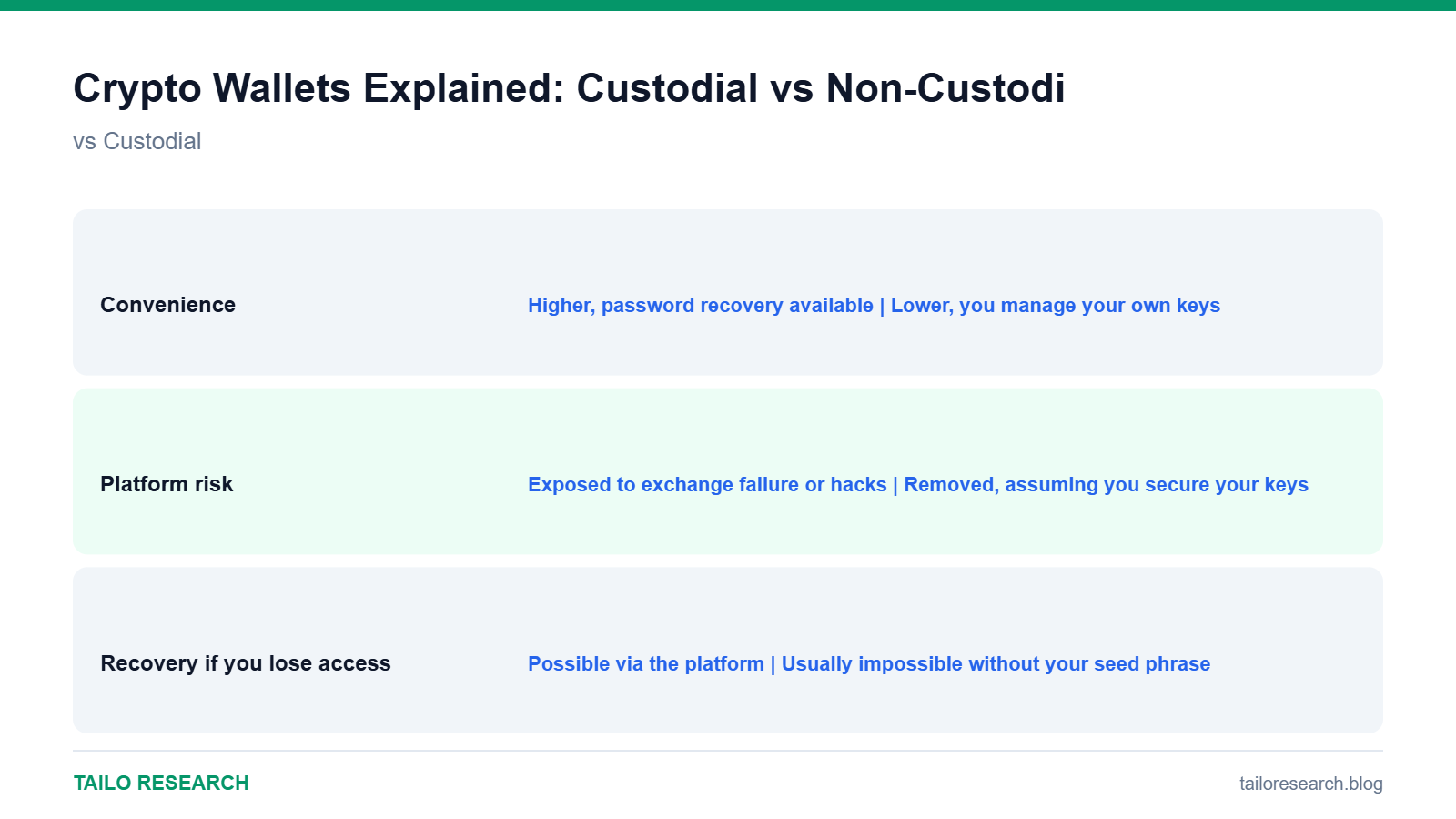
| Custodial | Non-custodial | |
|---|---|---|
| Convenience | Higher, password recovery available | Lower, you manage your own keys |
| Platform risk | Exposed to exchange failure or hacks | Removed, assuming you secure your keys |
| Recovery if you lose access | Possible via the platform | Usually impossible without your seed phrase |
A practical approach
- Keep only what you need for active trading on a custodial exchange wallet
- Consider moving larger, longer-term holdings to a non-custodial wallet
- Back up your seed phrase offline, in more than one secure location, if you go non-custodial
Key takeaways
- Custodial wallets trade control for convenience and recovery options.
- Non-custodial wallets give full control but full responsibility for security.
- Many holders use both: custodial for active trading, non-custodial for long-term storage.
Want to trade what you read here as a CFD alongside TradingView charts? Open a Vantage account. This is an affiliate link: we may earn a commission at no extra charge from us. CFDs are complex instruments and carry a high risk of losing money rapidly due to leverage; most retail accounts lose money.
Educational content only, not investment advice. Trading and investing involve risk, including the loss of your capital. Read our Risk Disclaimer and Affiliate Disclosure.


Leave a Reply