

The Bitcoin halving is one of the most closely watched events in crypto, a built-in, predictable reduction in how many new bitcoins are created. This guide explains the mechanism and what it does and does not tell you about future price.
What actually happens at a halving
Roughly every four years, or every 210,000 blocks, the reward miners receive for adding a new block to the Bitcoin blockchain is cut in half. The most recent halving occurred in April 2024, reducing the block reward. This is a hard-coded feature of Bitcoin’s protocol, not a decision made by any company or authority.
Why it reduces new supply growth
Halving events slow the rate at which new bitcoins enter circulation, gradually approaching Bitcoin’s hard cap of 21 million coins. If demand stays constant or grows while new supply growth slows, basic supply-and-demand logic suggests upward price pressure, though many other factors influence price at the same time.
What history shows, with a caveat
Bitcoin has seen major bull markets in the year or so following each of its past halvings. However, this is a small sample size (only a handful of halvings have occurred), and correlation is not the same as guaranteed causation — broader market conditions, adoption trends and macro factors have coincided with these cycles too.
Key takeaways
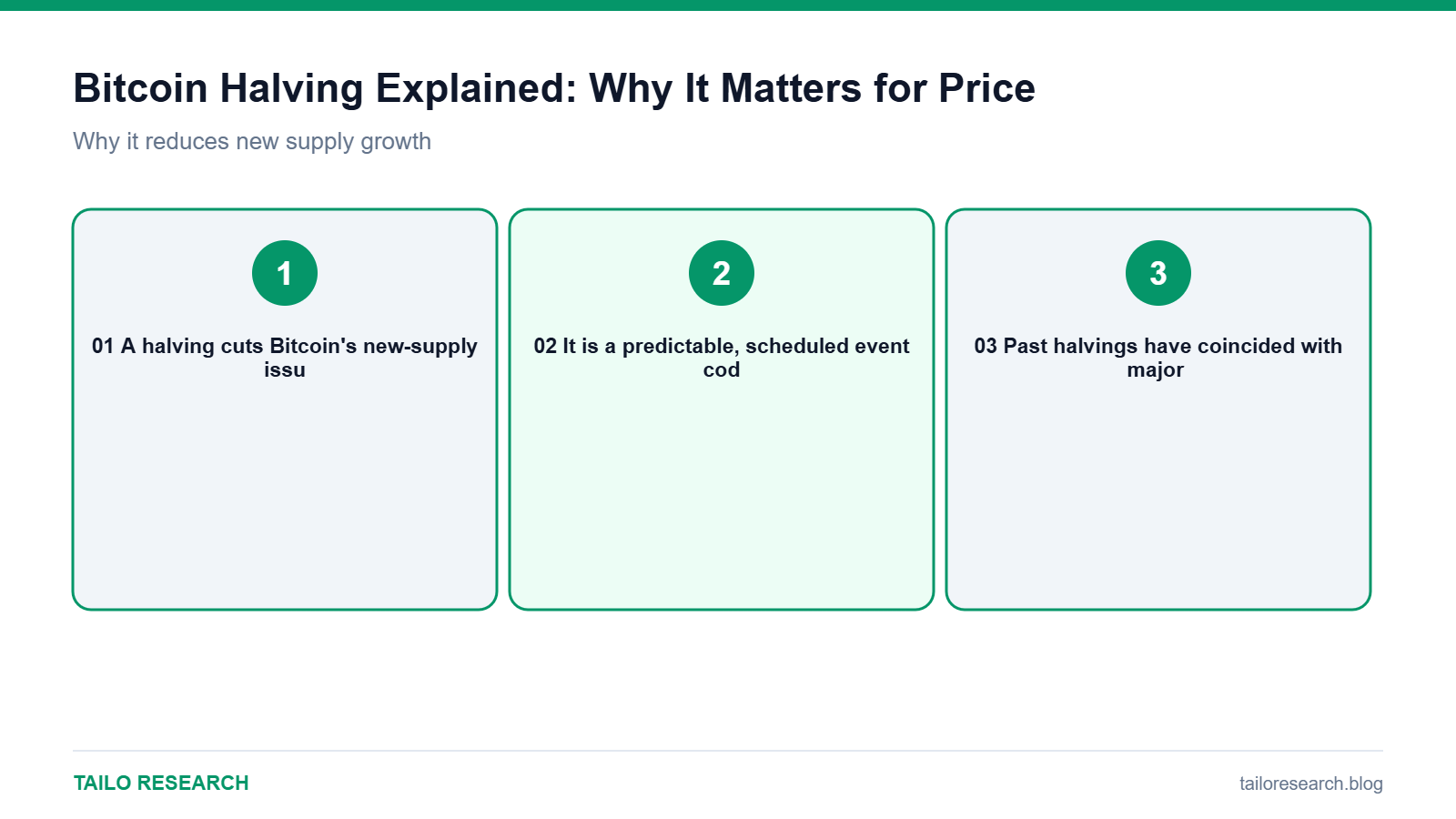
- A halving cuts Bitcoin’s new-supply issuance rate roughly every four years.
- It is a predictable, scheduled event coded into Bitcoin’s protocol.
- Past halvings have coincided with major bull markets, but this is a small sample and not a guarantee of future performance.
Want to trade what you read here as a CFD alongside TradingView charts? Open a Vantage account. This is an affiliate link: we may earn a commission at no extra charge from us. CFDs are complex instruments and carry a high risk of losing money rapidly due to leverage; most retail accounts lose money.
Educational content only, not investment advice. Trading and investing involve risk, including the loss of your capital. Read our Risk Disclaimer and Affiliate Disclosure.


Leave a Reply