

A stock split changes the number of shares outstanding and the share price, without changing the total value of your investment. This guide explains what actually happens.
How a split works
In a 2-for-1 split, each existing share becomes two shares, and the price is halved. If you owned 10 shares at $200 ($2,000 total), you now own 20 shares at $100 (still $2,000 total). Nothing about the company’s underlying value changes.
Why companies split their stock
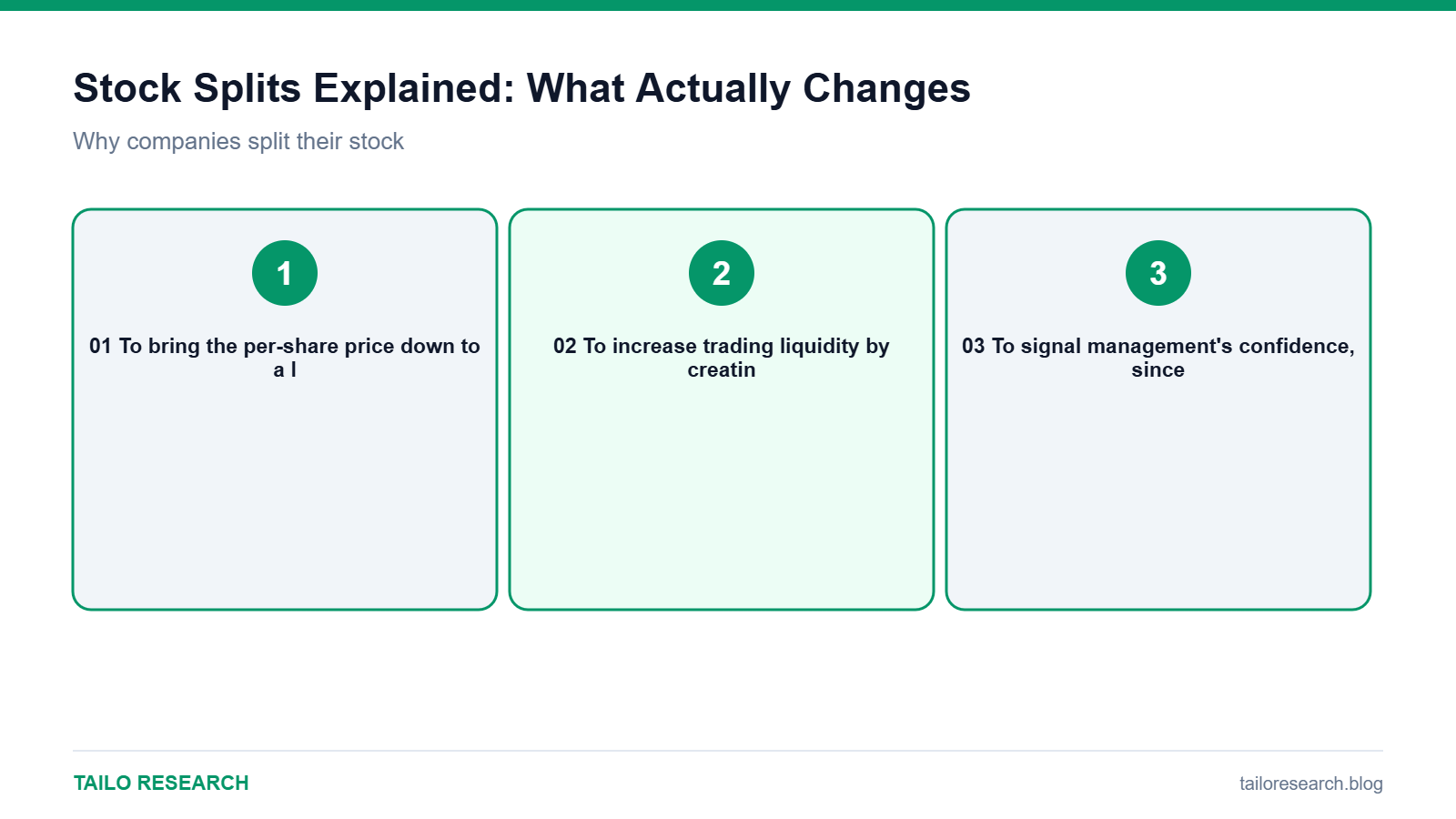
- To bring the per-share price down to a level more accessible to retail investors
- To increase trading liquidity by creating more shares in circulation
- To signal management’s confidence, since splits often follow a period of strong share-price growth
Reverse splits: the opposite move
A reverse split consolidates shares (for example, 1-for-10), raising the price per share while reducing the share count. Companies often use reverse splits to avoid delisting from an exchange with a minimum price requirement, and the market sometimes reads them as a warning sign rather than a positive one.
Does a split change anything real?
No, a split changes only the number of shares and the price per share, not the company’s market cap, earnings, or your proportional ownership. Any price reaction around a split is driven by sentiment and liquidity effects, not a change in fundamental value.
Key takeaways
- A stock split multiplies your shares and divides the price, leaving your total investment value unchanged.
- Companies split mainly to improve accessibility and liquidity.
- Reverse splits consolidate shares and often signal financial stress rather than strength.
Want to trade what you read here as a CFD alongside TradingView charts? Open a Vantage account. This is an affiliate link: we may earn a commission at no extra charge from us. CFDs are complex instruments and carry a high risk of losing money rapidly due to leverage; most retail accounts lose money.
Educational content only, not investment advice. Trading and investing involve risk, including the loss of your capital. Read our Risk Disclaimer and Affiliate Disclosure.


Leave a Reply