

A stock buyback (or share repurchase) is when a company buys its own shares back from the market, reducing the number of shares outstanding. This guide explains the mechanics and the debate around them.
How a buyback affects shareholders
Reducing the number of shares outstanding increases each remaining share’s claim on the company’s future earnings, which can boost earnings per share (EPS) even if total profit stays flat. This is often described as returning capital to shareholders, similar in effect to a dividend but without a direct cash payment.
Buybacks vs dividends
| Buybacks | Dividends | |
|---|---|---|
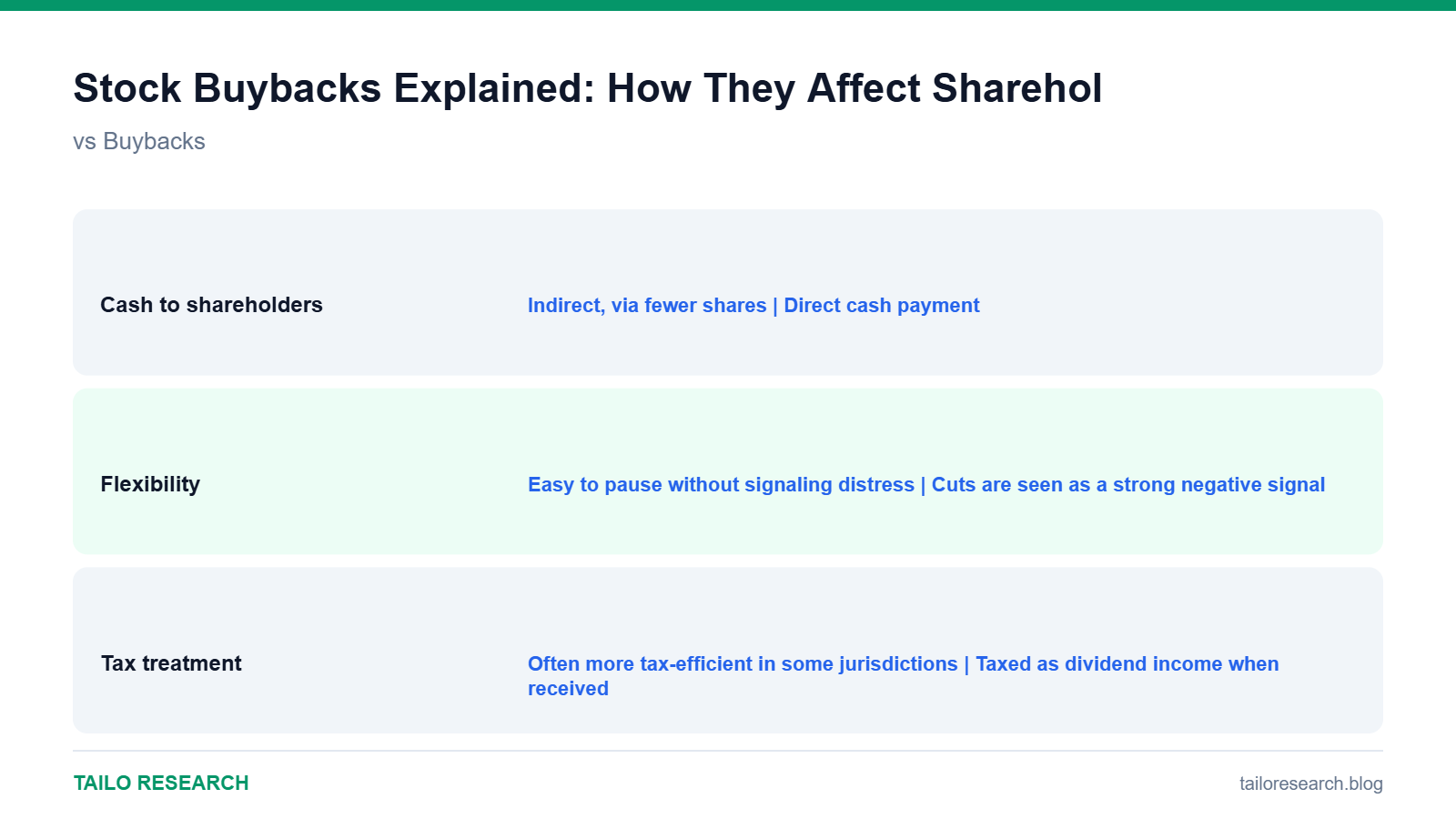
| Cash to shareholders | Indirect, via fewer shares | Direct cash payment |
| Flexibility | Easy to pause without signaling distress | Cuts are seen as a strong negative signal |
| Tax treatment | Often more tax-efficient in some jurisdictions | Taxed as dividend income when received |
The criticism
Critics argue some companies use buybacks to artificially boost EPS and executive compensation metrics rather than reinvesting in the business, or that buybacks at inflated share prices destroy value. Supporters argue buybacks are a flexible, tax-efficient way to return excess capital when a company has no better use for it.
What to check as an investor
- Whether the company is buying back stock at reasonable valuations, not at all-time highs funded by debt
- Whether buybacks are merely offsetting new share issuance (to employees, for example) rather than actually shrinking the share count
- How buybacks compare to the company’s other capital priorities, like debt reduction or growth investment
Key takeaways
- Buybacks reduce shares outstanding, which can boost EPS even without profit growth.
- They are more flexible than dividends but attract criticism when poorly timed or used to inflate metrics.
- Check whether buybacks are meaningfully shrinking share count, not just offsetting new issuance.
Want to trade what you read here as a CFD alongside TradingView charts? Open a Vantage account. This is an affiliate link: we may earn a commission at no extra charge from us. CFDs are complex instruments and carry a high risk of losing money rapidly due to leverage; most retail accounts lose money.
Educational content only, not investment advice. Trading and investing involve risk, including the loss of your capital. Read our Risk Disclaimer and Affiliate Disclosure.


Leave a Reply