


Market capitalization, or market cap, is the total value the stock market places on a company. It is one of the simplest and most widely used ways to categorize stocks.
How market cap is calculated
Market cap = share price x total shares outstanding. A company with 1 billion shares trading at $50 has a $50 billion market cap, regardless of its revenue or profit.
The common size categories
| Category | Rough range |
|---|---|
| Mega-cap | Over $200 billion |
| Large-cap | $10 billion – $200 billion |
| Mid-cap | $2 billion – $10 billion |
| Small-cap | $300 million – $2 billion |
| Micro-cap | Under $300 million |
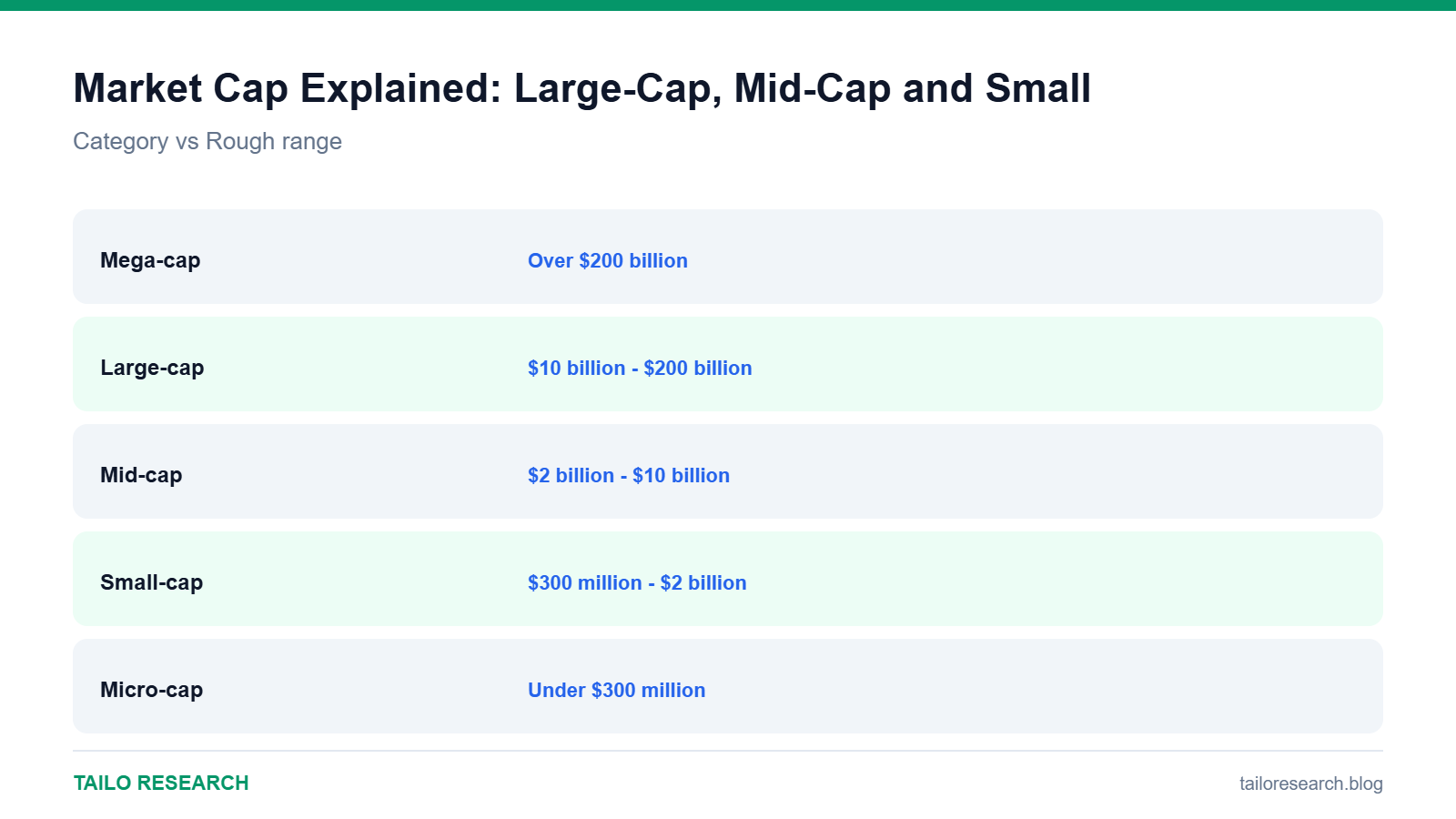
These thresholds are commonly used approximations and vary slightly by index provider.
Why the category matters
- Volatility: smaller companies tend to swing more than larger ones
- Liquidity: mega- and large-cap stocks are generally easier to trade in size without moving the price
- Growth potential: smaller companies have more room to grow, but also higher failure risk
- Index inclusion: market cap determines eligibility for major indices like the S&P 500
Key takeaways
- Market cap equals share price multiplied by shares outstanding.
- It categorizes companies from micro-cap to mega-cap, each with a different risk and volatility profile.
- Market cap alone says nothing about profitability or debt, so it should not be used in isolation.
Want to trade what you read here as a CFD alongside TradingView charts? Open a Vantage account. This is an affiliate link: we may earn a commission at no extra charge from us. CFDs are complex instruments and carry a high risk of losing money rapidly due to leverage; most retail accounts lose money.
Educational content only, not investment advice. Trading and investing involve risk, including the loss of your capital. Read our Risk Disclaimer and Affiliate Disclosure.


Leave a Reply