

International ETFs give US-based investors exposure to companies outside the United States, spanning developed and emerging markets. This guide covers the main types and what to watch for.
Main categories
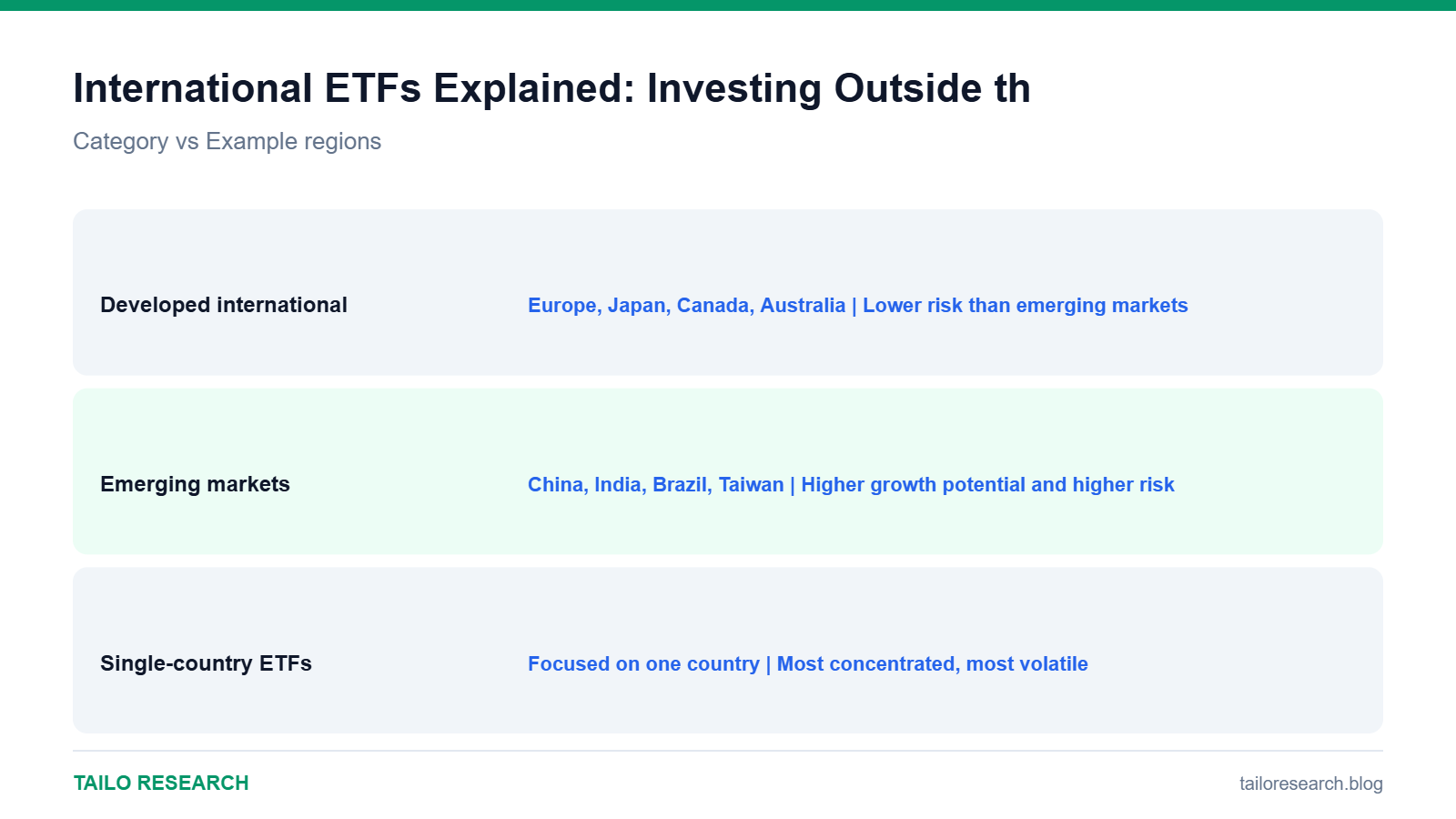
| Category | Example regions | Typical risk profile |
|---|---|---|
| Developed international | Europe, Japan, Canada, Australia | Lower risk than emerging markets |
| Emerging markets | China, India, Brazil, Taiwan | Higher growth potential and higher risk |
| Single-country ETFs | Focused on one country | Most concentrated, most volatile |
Why diversify outside the US
US markets have outperformed most other regions over the past decade, but market leadership rotates over longer periods. International diversification reduces the risk of being entirely dependent on one country’s economic and market cycle.
Currency risk
Unhedged international ETFs carry currency risk: your returns are affected by how the foreign currency moves against the US dollar, in addition to how the underlying stocks perform. Some funds offer a currency-hedged version that removes most of this effect, at a higher expense ratio.
Key takeaways
- International ETFs range from developed-market funds to concentrated single-country funds.
- Emerging-market ETFs offer higher growth potential alongside higher risk.
- Unhedged international funds carry currency risk on top of stock-price risk.
Want to trade what you read here as a CFD alongside TradingView charts? Open a Vantage account. This is an affiliate link: we may earn a commission at no extra charge from us. CFDs are complex instruments and carry a high risk of losing money rapidly due to leverage; most retail accounts lose money.
Educational content only, not investment advice. Trading and investing involve risk, including the loss of your capital. Read our Risk Disclaimer and Affiliate Disclosure.


Leave a Reply