

These three terms get used interchangeably, but they describe different things: two are about legal structure (ETF vs mutual fund) and one is about strategy (index vs actively managed). This guide untangles them.
The two separate questions
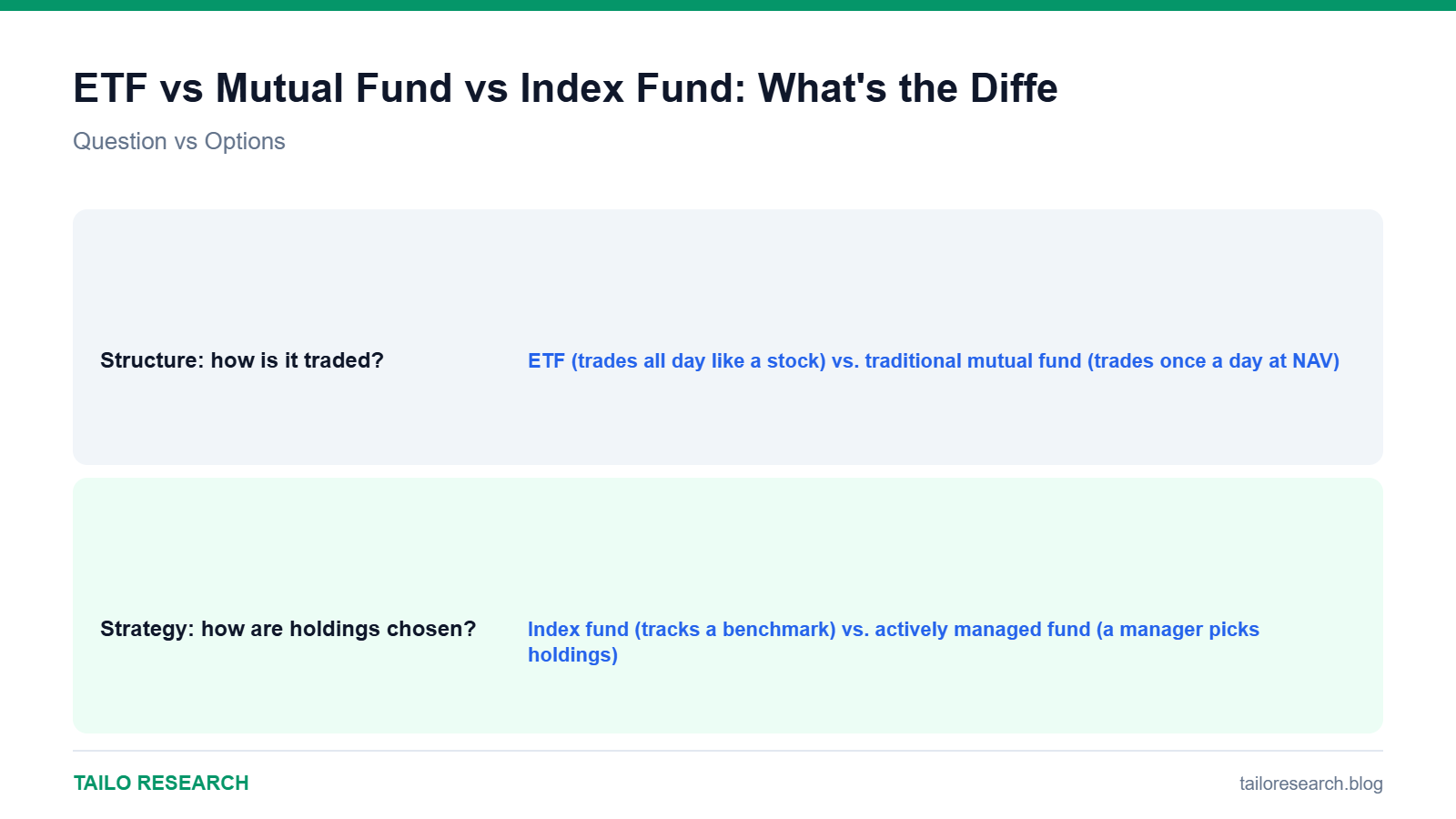
| Question | Options |
|---|---|
| Structure: how is it traded? | ETF (trades all day like a stock) vs. traditional mutual fund (trades once a day at NAV) |
| Strategy: how are holdings chosen? | Index fund (tracks a benchmark) vs. actively managed fund (a manager picks holdings) |
So an index fund can be either an ETF or a mutual fund
VOO is an index fund because it tracks the S&P 500, and it is also an ETF because of how it trades. A traditional S&P 500 index mutual fund tracks the same index but only trades once a day at the end-of-day net asset value, not throughout the trading session.
Key practical differences
- Trading flexibility: ETFs trade all day at live market prices; mutual funds settle once daily
- Minimum investment: ETFs can often be bought as a single share; mutual funds sometimes require a minimum dollar investment
- Tax efficiency: ETFs are often more tax-efficient than mutual funds in taxable accounts, due to how shares are created and redeemed
- Cost: index funds (either wrapper) are typically far cheaper than actively managed funds
Key takeaways
- ETF vs mutual fund is about trading structure; index vs actively managed is about strategy.
- An index fund can exist as either an ETF or a mutual fund.
- ETFs generally offer more trading flexibility and tax efficiency than traditional mutual funds.
Want to trade what you read here as a CFD alongside TradingView charts? Open a Vantage account. This is an affiliate link: we may earn a commission at no extra charge from us. CFDs are complex instruments and carry a high risk of losing money rapidly due to leverage; most retail accounts lose money.
Educational content only, not investment advice. Trading and investing involve risk, including the loss of your capital. Read our Risk Disclaimer and Affiliate Disclosure.


Leave a Reply