

Disclosure: Tailo Research is an affiliate partner of Vantage and may earn a commission if you open an account through our Vantage links. See our Affiliate Disclosure.
Vantage and Exness both serve global CFD traders across multiple regulated entities, but their account structures and platform choices differ meaningfully. Here is how they compare on regulation, cost and platforms. Figures reflect September 2026.
At a glance
| Vantage | Exness | |
|---|---|---|
| Founded | 2009 | 2008 |
| Key regulators | ASIC, FCA, FSCA, CIMA, VFSC | FCA, CySEC, FSCA, FSA Seychelles, CBCS, FSC (Mauritius/BVI), CMA |
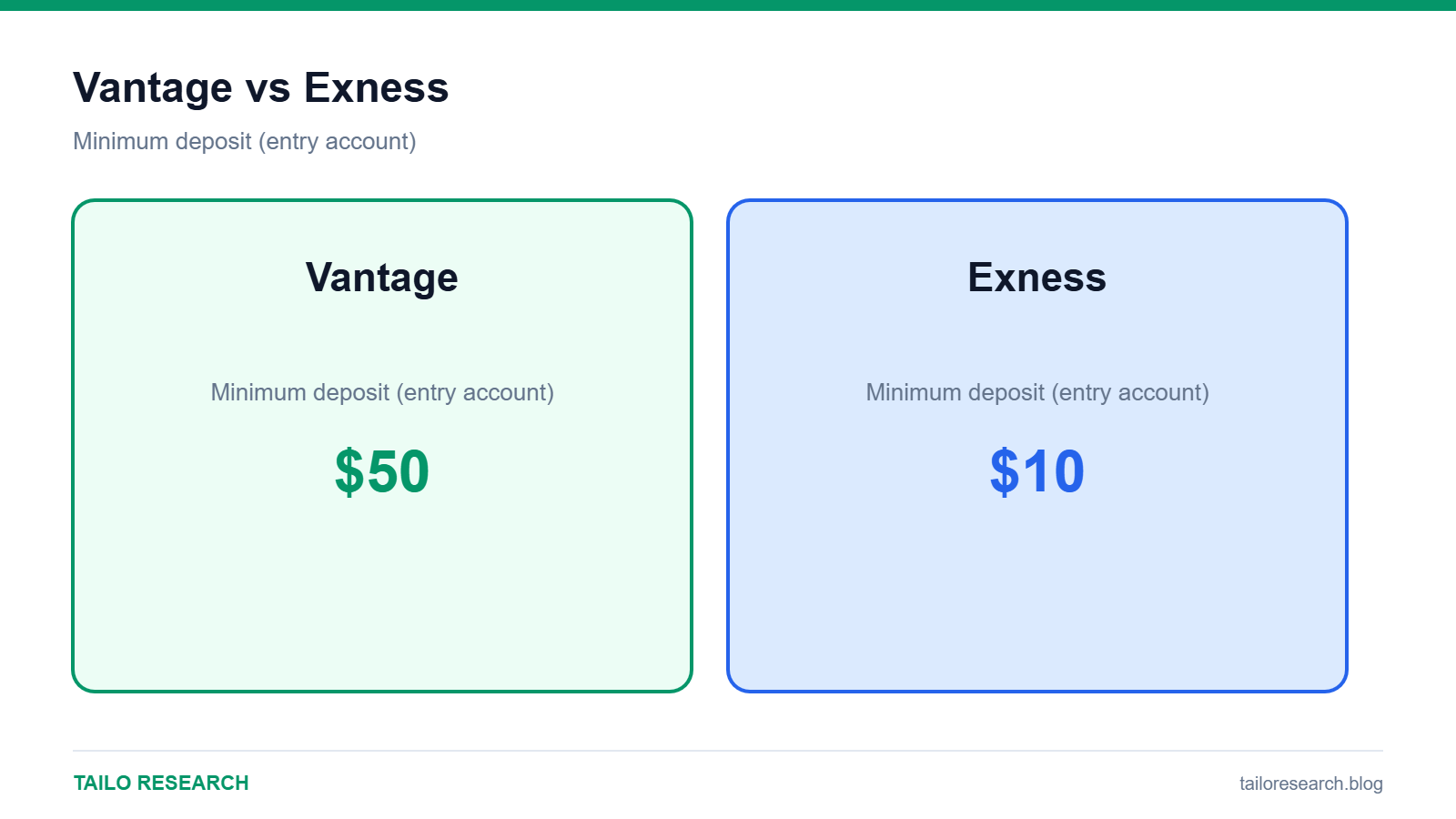
| Minimum deposit | $50 (Standard/Raw) | $10 (Standard/Cent), $200 (Pro/Raw/Zero) |
| Max leverage (offshore) | Up to 1:1000 | Up to 1:2000, or unlimited on some accounts |
| Platforms | MT4, MT5, ProTrader (TradingView charting) | MT4, MT5, Exness Terminal |
An important regulatory nuance
Exness holds FCA and CySEC licenses, but Exness’s own regulatory disclosure states that its Cyprus (CySEC) and UK (FCA) entities do not offer trading services to retail clients. In practice, most retail traders — including many in the EU and UK — are onboarded through Exness’s Seychelles entity, which carries no statutory compensation scheme. Vantage’s FCA entity, by contrast, does serve retail clients directly. This is worth checking carefully before you assume “FCA-regulated” means you get FCA-level retail protection with either broker — always confirm which entity your account actually opens under.
Cost and minimum deposit
Exness’s Standard account has a notably low $10 minimum deposit, undercutting Vantage’s $50, though Exness’s Raw Spread/Zero/Pro accounts require $200, higher than Vantage’s Raw ECN minimum. Exness is widely known for very high offshore leverage caps and fast, largely automated withdrawals, with sources reporting over 98% of withdrawal requests processed automatically.
Platforms
Neither broker offers cTrader. Exness runs MT4, MT5 and its own Exness Terminal; Vantage runs MT4, MT5 and ProTrader with TradingView-style charting. If TradingView-based charting matters to you, Vantage’s ProTrader is the more direct fit of the two.
Who each broker suits
- Traders who want the lowest entry-level deposit: Exness’s $10 Standard account
- Traders who want direct retail access under an FCA entity: Vantage
- Traders prioritizing very fast, automated withdrawals: Exness
- Traders who want TradingView-style charting built in: Vantage’s ProTrader
Key takeaways
- Exness has a lower entry deposit on its Standard account; Vantage’s FCA entity serves retail clients directly, unlike Exness’s FCA and CySEC entities.
- Exness advertises very high or unlimited offshore leverage; both brokers cap Tier-1 retail leverage at 1:30.
- Neither broker offers cTrader; Vantage’s ProTrader leans on TradingView-style charting.
Ready to open an account? Open a Vantage account. This is an affiliate link: we may earn a commission at no extra charge from us. CFDs are complex instruments and carry a high risk of losing money rapidly due to leverage; most retail accounts lose money.
Educational content only, not investment advice. Trading and investing involve risk, including the loss of your capital. Read our Risk Disclaimer and Affiliate Disclosure.


Leave a Reply