

Leveraged ETFs like TQQQ (3x Nasdaq-100) promise to multiply an index’s daily return, but the mechanics behind that promise trip up many investors who treat them like ordinary long-term holdings.
How leveraged ETFs actually work
A leveraged ETF uses derivatives to target a multiple, typically 2x or 3x, of its underlying index’s return for a single day. Critically, this target resets daily, which is the source of most confusion about how these funds behave.
Why daily reset matters: volatility decay
Because the leverage resets each day, returns compound daily rather than simply multiplying the index’s return over longer periods. In a choppy, sideways market, this compounding can cause a leveraged ETF to lose value even if the underlying index ends flat over the same period, an effect known as volatility decay.
A simplified example
If an index rises 10% one day and falls 10% the next, it ends down about 1% overall. A 3x leveraged version rises 30% then falls 30%, ending down closer to 9% — a much steeper loss than 3x the index’s actual 1% decline. This is illustrative math, not a specific fund’s real performance.
What leveraged ETFs are actually designed for
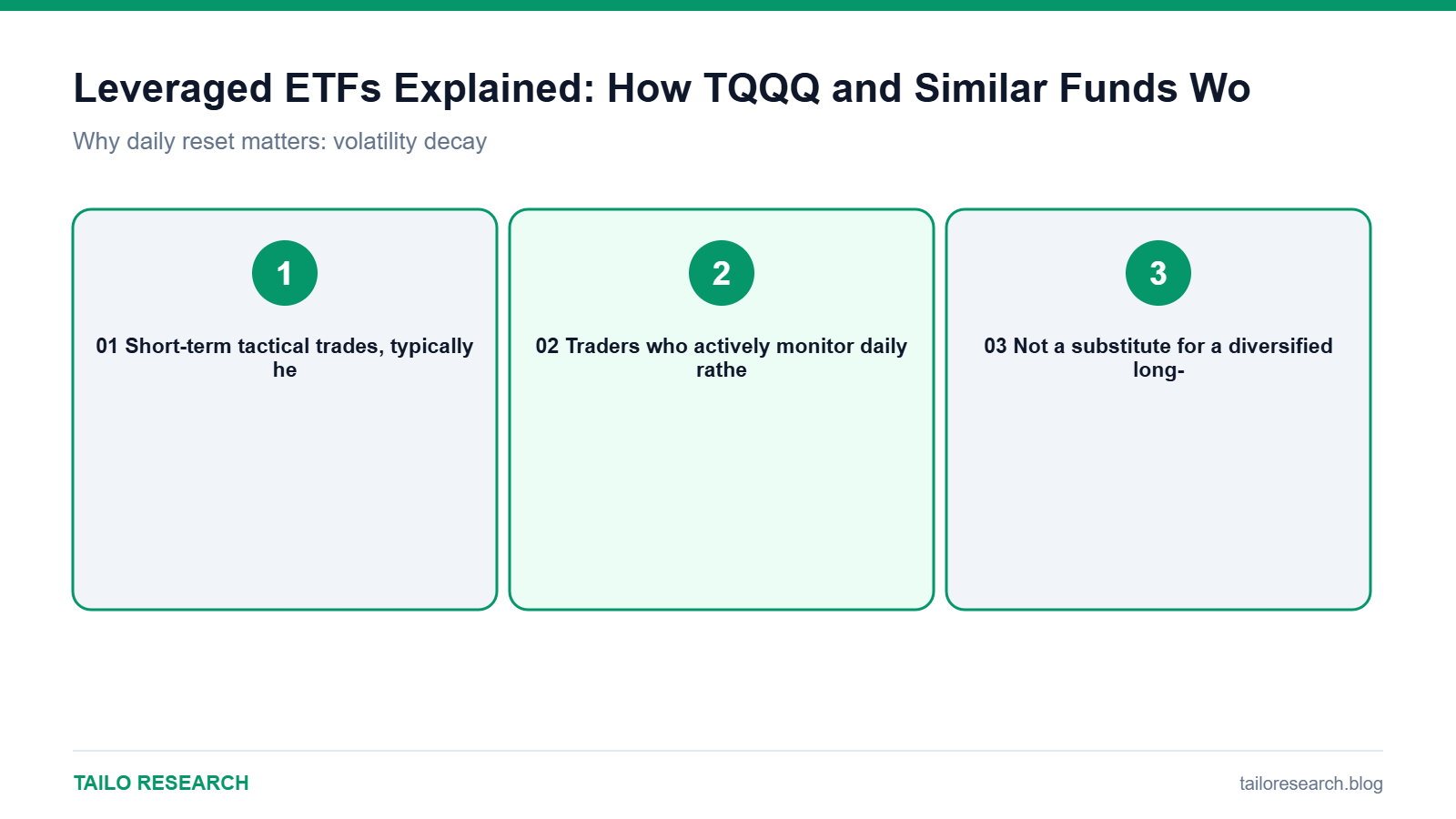
- Short-term tactical trades, typically held for days, not months or years
- Traders who actively monitor daily rather than buy-and-hold investors
- Not a substitute for a diversified long-term core holding
Key takeaways
- Leveraged ETFs target a multiple of daily returns, and that target resets every day.
- Volatility decay can cause losses even when the underlying index ends flat over time.
- They are short-term trading tools, not long-term investments.
Want to trade what you read here as a CFD alongside TradingView charts? Open a Vantage account. This is an affiliate link: we may earn a commission at no extra charge from us. CFDs are complex instruments and carry a high risk of losing money rapidly due to leverage; most retail accounts lose money.
Educational content only, not investment advice. Trading and investing involve risk, including the loss of your capital. Read our Risk Disclaimer and Affiliate Disclosure.


Leave a Reply