

Earnings season, the few weeks each quarter when most public companies report results, is one of the most volatile and important periods for stock prices. This guide explains what to look for in a quarterly report and how to read the market’s reaction.
When earnings season happens
US companies generally report quarterly, with the busiest reporting weeks starting a couple of weeks after each quarter ends: mid-to-late January, April, July and October. Large banks typically kick off each season, followed by a wide range of sectors over the following weeks.
The core numbers to check first
| Metric | What it tells you |
|---|---|
| Revenue | Whether the top line is growing, and how fast |
| EPS (earnings per share) | Profit per share, usually compared against analyst estimates |
| Guidance | Management’s outlook for the next quarter or year, often more market-moving than the results themselves |
| Margins | Whether the company is becoming more or less profitable per dollar of revenue |
Why guidance often matters more than the headline numbers
A company can beat both revenue and EPS estimates and still see its stock fall if management guides lower for the next quarter. Markets are forward-looking, so a strong quarter with weak guidance is often read as bad news, while a weak quarter with strong guidance can send a stock higher. Always check what management said about the road ahead, not just the quarter that already happened.
Reading the earnings call, not just the press release
The press release and slide deck give you the numbers. The earnings call, where executives take analyst questions, often reveals more: how confident management sounds, what risks they flag unprompted, and which questions they answer vaguely. Transcripts are typically available within hours of the call ending.
How the market can react in surprising ways
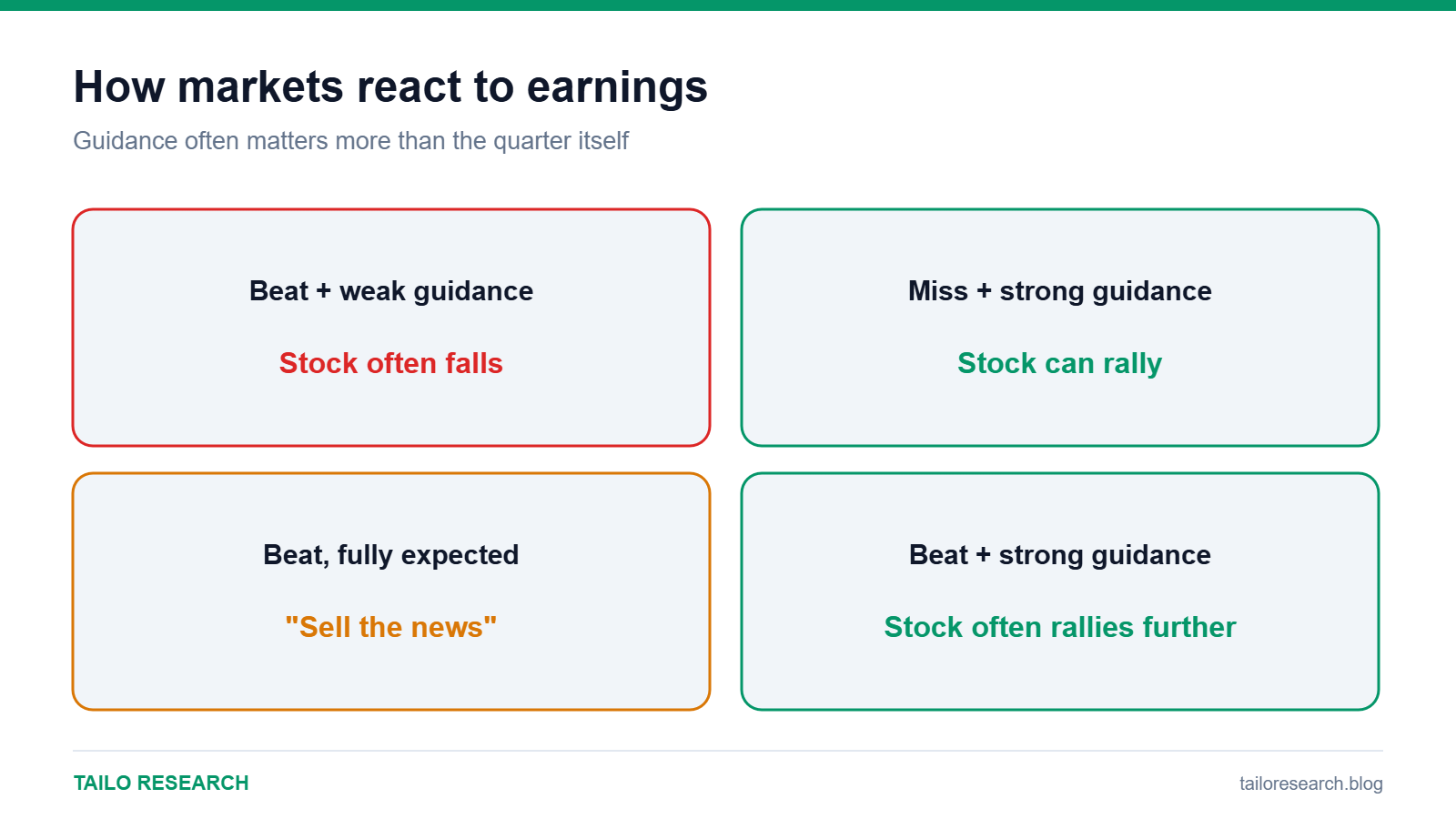
- Beat and drop: results beat estimates but guidance disappoints
- Miss and rally: results miss estimates but the miss was already priced in, or guidance improves
- Sell the news: a good quarter that was already fully expected, so there is little fresh reason to buy
- Sector spillover: one company’s results move peers in the same industry, even before they report
Where to find primary sources
In the US, official quarterly (10-Q) and annual (10-K) filings are free on the SEC’s EDGAR database, and companies publish earnings releases and call transcripts on their own investor relations pages. These primary sources are more reliable than secondhand summaries, especially for the numbers that matter to your specific analysis.
A simple checklist for earnings season
- Check the actual numbers against analyst estimates, not just against the prior year
- Read or listen to the guidance section closely
- Note any one-off items that flatter or distort the headline numbers
- Check how the stock reacts in the first hour of trading versus how it settles by the close
- For your own holdings, compare this quarter’s trend against the last two to three quarters, not just one data point
Key takeaways
- Guidance often moves stocks more than the quarter that already happened.
- A beat or miss against estimates matters more than the raw revenue and EPS numbers alone.
- Primary sources like SEC filings and earnings call transcripts are more reliable than secondhand summaries.
Want to trade what you read here as a CFD alongside TradingView charts? Open a Vantage account. This is an affiliate link: we may earn a commission at no extra charge from us. CFDs are complex instruments and carry a high risk of losing money rapidly due to leverage; most retail accounts lose money.
Educational content only, not investment advice. Trading and investing involve risk, including the loss of your capital. Read our Risk Disclaimer and Affiliate Disclosure.


Leave a Reply