


Gold (GC) and crude oil (CL) are two of the most actively traded commodity futures, and both are available in smaller micro-sized contracts for traders who want to manage risk in finer increments. This guide covers the specs for both, standard and micro.
Gold futures (GC and MGC)
| Item | GC (standard) | MGC (micro) |
|---|---|---|
| Contract size | 100 troy ounces | 10 troy ounces |
| Tick size | $0.10 per ounce | $0.10 per ounce |
| Tick value | $10.00 | $1.00 |
| Settlement | Physical delivery (close before First Notice Day for speculators) | Physical delivery (same rule) |
At a gold price of $2,400 per ounce, one GC contract represents $240,000 of notional exposure, while one MGC contract represents $24,000, roughly one-tenth the size. Retail traders almost always close their position well before First Notice Day to avoid the delivery process, which is designed for commercial participants, not speculators.
Crude oil futures (CL and MCL)
| Item | CL (standard) | MCL (micro) |
|---|---|---|
| Contract size | 1,000 barrels | 100 barrels |
| Tick size | $0.01 per barrel | $0.01 per barrel |
| Tick value | $10.00 | $1.00 |
| Settlement | Physical delivery (speculators close before expiry) | Physical delivery (same rule) |
At a crude oil price of $75 per barrel, one CL contract represents $75,000 of notional exposure, and one MCL contract represents $7,500. Like gold, retail traders roll or close positions before delivery obligations begin.
A simple position-sizing example
Suppose you risk 1% of a $10,000 account, or $100, on a single trade. If your stop on gold is 20 ticks away, that costs 20 x $10 = $200 per GC contract, over your limit, but 20 x $1 = $20 per MGC contract, comfortably inside it. This is illustrative arithmetic, not a recommendation, but it shows why many retail traders start with micro contracts on higher-priced commodities like gold.
What moves gold and oil prices
- Gold: real interest rates, the US dollar, central bank buying, and demand as a safe-haven asset during uncertainty
- Oil: OPEC+ production decisions, global demand (especially from the US and China), inventory data, and geopolitical supply disruptions
Trading hours and scheduled data
Both GC and CL trade nearly around the clock on CME/NYMEX, Sunday evening through Friday afternoon (US Eastern Time), with short daily breaks. Weekly US crude inventory data (EIA, released Wednesdays) is one of the most-watched scheduled events for oil traders, and tends to produce sharp, brief volatility spikes.
Key takeaways
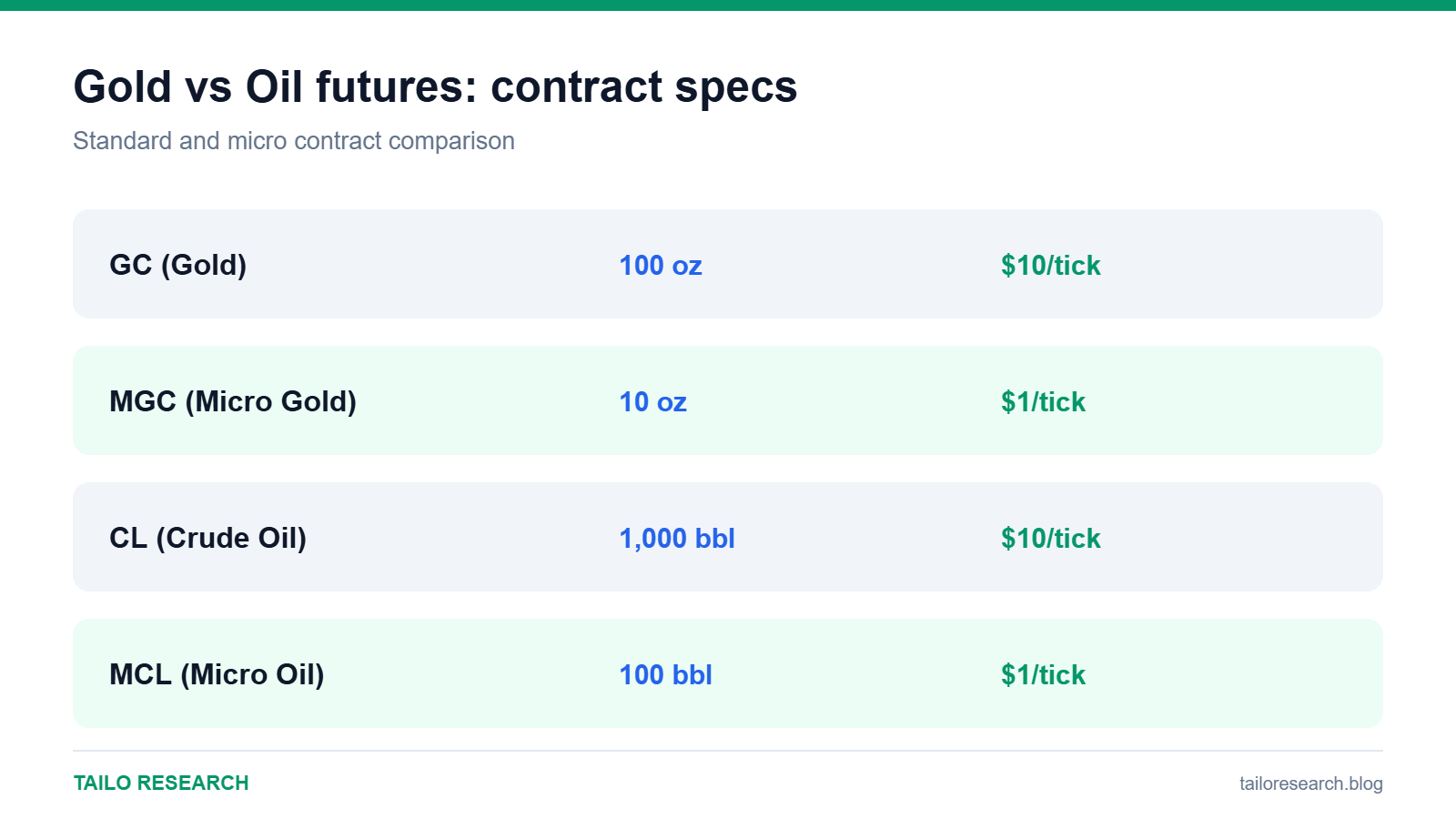
- GC (gold) is 100 oz per contract at $10/tick; MGC is one-tenth the size at $1/tick.
- CL (crude oil) is 1,000 barrels per contract at $10/tick; MCL is one-tenth the size at $1/tick.
- Both are physically settled, so speculators close or roll positions before delivery windows begin.
Want to trade what you read here as a CFD alongside TradingView charts? Open a Vantage account. This is an affiliate link: we may earn a commission at no extra charge from us. CFDs are complex instruments and carry a high risk of losing money rapidly due to leverage; most retail accounts lose money.
Educational content only, not investment advice. Trading and investing involve risk, including the loss of your capital. Read our Risk Disclaimer and Affiliate Disclosure.


Leave a Reply