

Ethereum is the second-largest cryptocurrency by market value and the leading platform for smart contracts, the self-executing code that powers most of the crypto industry beyond simple payments. This guide covers how Ethereum works, what ETH is used for, and the main ways to get exposure to it.
What Ethereum actually is
Ethereum is a decentralized, programmable blockchain launched in 2015. Unlike Bitcoin, which is primarily a payment and store-of-value network, Ethereum is designed to run smart contracts: code that executes automatically when conditions are met. This is the foundation for decentralized finance (DeFi), NFTs, and thousands of applications built on top of the network. Ether (ETH) is the native currency used to pay for computation on the network, known as “gas.”
The Merge: how Ethereum changed in 2022
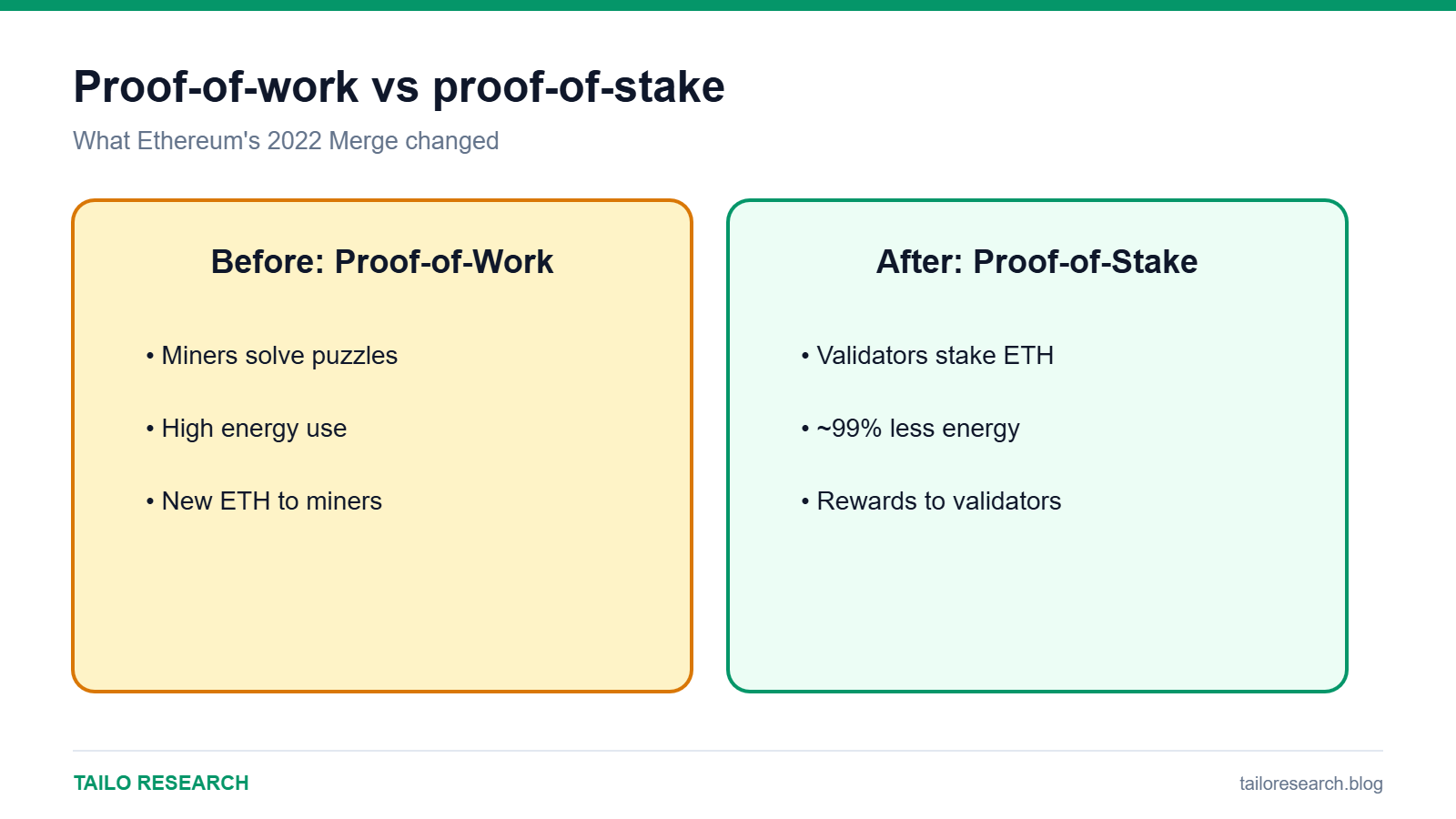
In September 2022, Ethereum completed “The Merge,” switching from proof-of-work mining to proof-of-stake validation. Under proof-of-stake, validators lock up (stake) ETH to help secure the network and earn rewards, replacing the energy-intensive mining process Bitcoin still uses. This cut Ethereum’s energy consumption by over 99% and changed ETH’s supply dynamics, since transaction fees are partly burned rather than paid entirely to miners.
What moves the price of Ethereum
- Network activity: usage of DeFi, NFTs and other applications built on Ethereum
- Staking dynamics: how much ETH is locked in staking versus freely traded
- Competition: rival smart-contract platforms competing for developers and users
- Broader crypto sentiment: Ethereum tends to move with Bitcoin and the wider crypto market, though not always in lockstep
- Regulation and ETF flows: spot Ethereum ETFs, approved in the US in 2024, opened a regulated route for institutional demand
Ways to get exposure to Ethereum
| Method | What you get | Things to know |
|---|---|---|
| Buy on a crypto exchange | You own actual ETH | You choose custody: exchange wallet or your own |
| Spot Ethereum ETF | Shares in a fund that holds ETH | Trades in a normal brokerage account during market hours |
| Staking | ETH locked up to earn rewards | Funds are typically less liquid while staked |
| Futures | A contract on ETH’s price | Leverage and expiry apply |
| CFDs | A derivative that tracks the price | No ownership, leverage and financing costs apply |
Ethereum vs Bitcoin: the core difference
Bitcoin’s core value proposition is scarcity and simplicity: a fixed 21 million supply and a network optimized for secure value transfer. Ethereum’s value proposition is programmability: a platform other applications and tokens are built on top of. This makes Ethereum more directly tied to how much real economic activity happens on its network, while Bitcoin is more often compared to a scarce digital asset like gold.
Risks to understand
- Volatility: ETH can move sharply in both directions, often more than Bitcoin on a percentage basis
- Smart contract risk: applications built on Ethereum can have bugs or exploits, even if the underlying network itself is secure
- Regulatory uncertainty: rules for crypto assets and DeFi are still evolving in many countries
- Custody risk: losing private keys or using an insecure platform can mean losing your ETH permanently
Key takeaways
- Ethereum is a programmable blockchain; ETH is the currency used to pay for computation on it.
- The 2022 Merge moved Ethereum to proof-of-stake, changing its energy use and supply dynamics.
- You can get exposure through direct ownership, staking, spot ETFs, futures or CFDs, each with different risk and liquidity trade-offs.
Want to trade what you read here as a CFD alongside TradingView charts? Open a Vantage account. This is an affiliate link: we may earn a commission at no extra charge from us. CFDs are complex instruments and carry a high risk of losing money rapidly due to leverage; most retail accounts lose money.
Educational content only, not investment advice. Trading and investing involve risk, including the loss of your capital. Read our Risk Disclaimer and Affiliate Disclosure.


Leave a Reply