

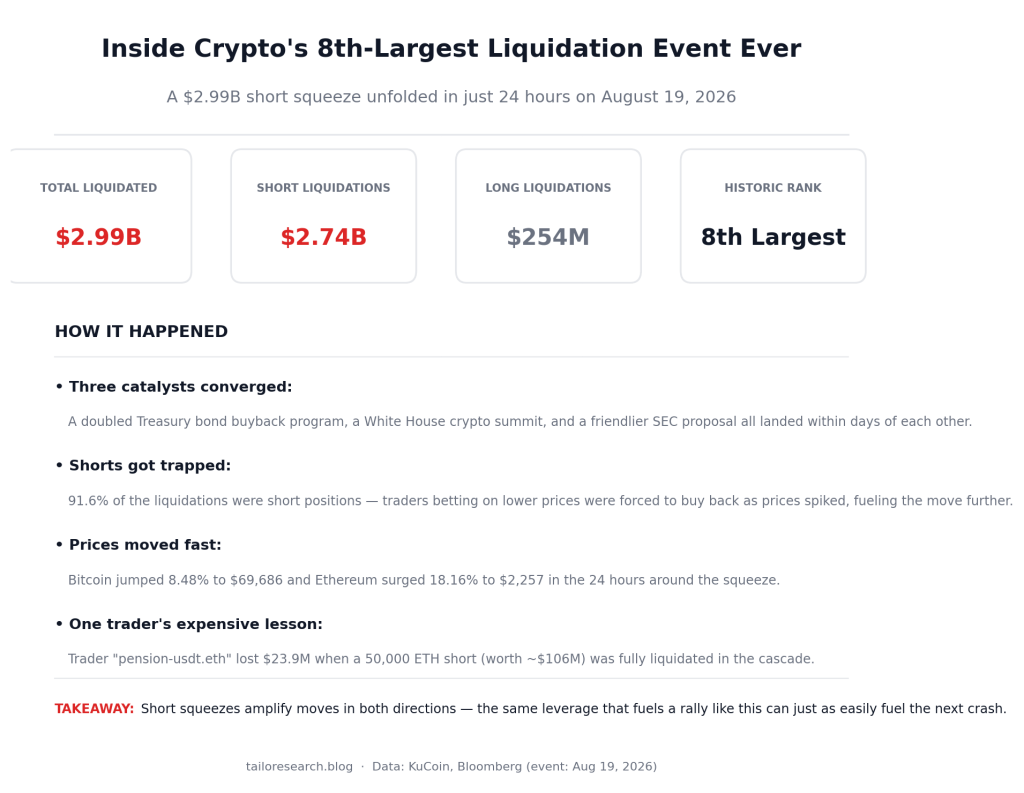
On August 19, 2026, crypto markets saw one of the most violent short squeezes in the industry’s history: $2.99 billion in leveraged positions liquidated in a single 24-hour window, ranking as the 8th-largest liquidation event ever recorded. Bitcoin jumped 8.48% to $69,686 and Ethereum surged 18.16% to $2,257 as the cascade unfolded. Here’s what actually happened, and what it tells traders about the risk still built into this market.
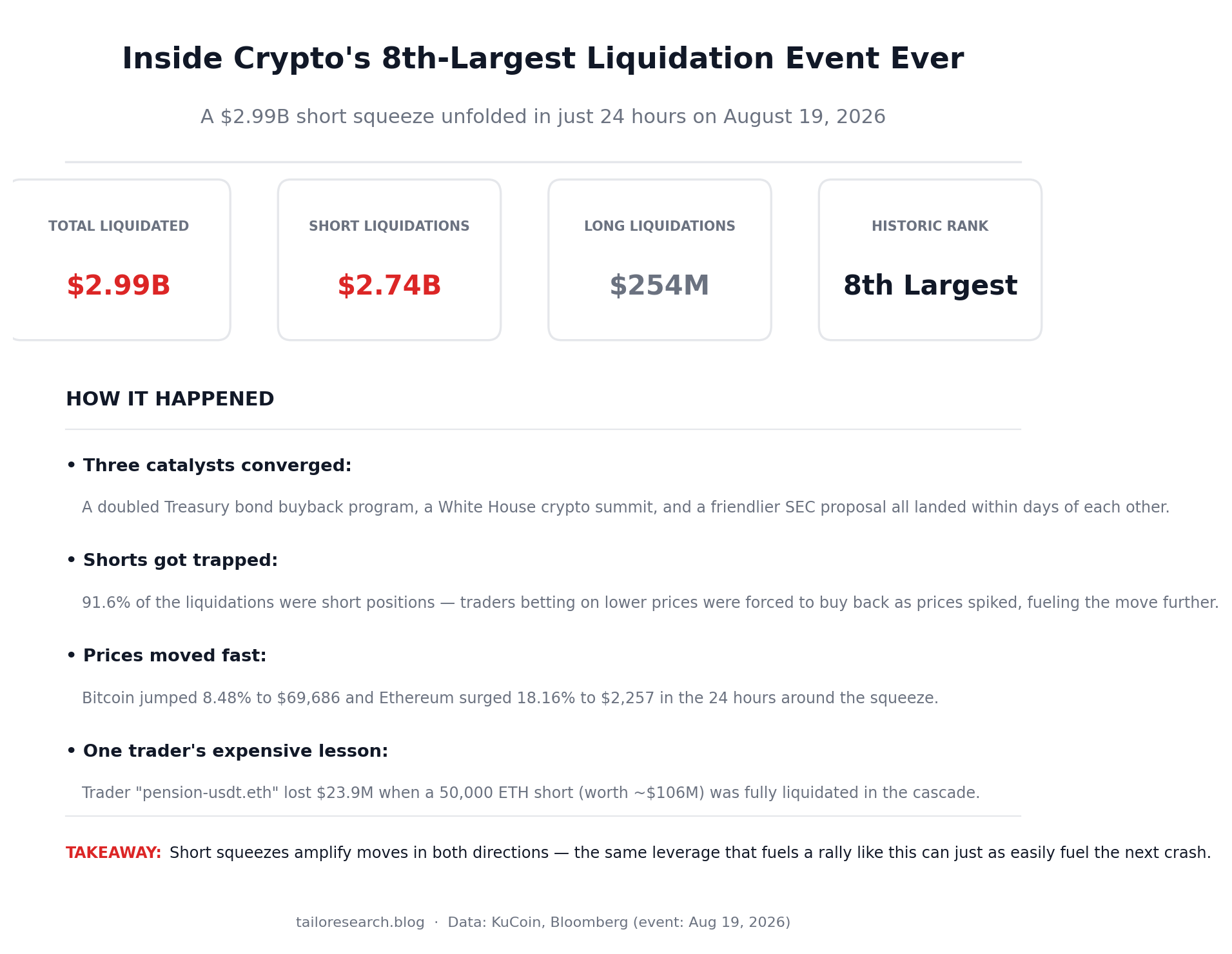
How It Happened
- Three catalysts converged: a doubled US Treasury bond buyback program, a White House crypto summit, and a friendlier SEC digital-asset proposal all landed within days of each other, creating a sudden wave of bullish momentum.
- Shorts got trapped: 91.6% of the $2.99 billion liquidated — about $2.74 billion — came from short positions. Traders betting on lower prices were forced to buy back as prices spiked, and that forced buying pushed prices higher still, fueling the cascade further.
- Prices moved fast: Bitcoin’s 8.48% move and Ethereum’s 18.16% move both happened within the same 24-hour window, leaving very little time for leveraged short sellers to react before their positions were automatically closed out.
- One trader’s expensive lesson: a trader known as “pension-usdt.eth” lost $23.9 million when a 50,000 ETH short position, worth roughly $106 million, was fully liquidated in the cascade — a stark illustration of how quickly leverage can turn against a position.
Why Short Squeezes Amplify Moves
A short squeeze is mechanically self-reinforcing. When a trader shorts an asset, they’ve effectively borrowed and sold it, betting they can buy it back cheaper later. If the price rises instead, their exchange eventually forces them to buy back at a loss to close the position — and that forced buying adds more upward pressure on the price, which can trigger the next wave of liquidations. With $2.74 billion in shorts wiped out in a day, that mechanism did most of the heavy lifting behind August 19’s rally — which is exactly why gains built this way can reverse just as fast once the forced buying runs out.
What This Means If You’re Trading Crypto
- Leverage cuts both ways, hard: the same mechanics that erased $2.99 billion in one day can just as easily wipe out long positions in the next downturn — this event is a reminder of how much leverage sits in this market at any given time.
- Liquidation data is a real signal: tracking aggregate long/short liquidation levels can help identify when a market is overextended in one direction and vulnerable to a squeeze.
- Size positions for volatility, not just direction: an 8-18% move in 24 hours is exceptional even by crypto standards — position sizing and stop-loss discipline matter more after an event like this, not less.
- This event, not new demand, explains part of August’s rally: when evaluating whether Bitcoin and Ethereum’s recent strength is durable, it’s worth separating genuine new buying from short-covering-driven spikes like this one.
Trading through volatile liquidation cascades requires a broker that can execute reliably when markets move fast. Vantage Markets offers tight spreads and dependable execution on major crypto pairs, plus the risk-management tools to help you manage leverage responsibly in moments exactly like this one.
Related reading: Bitcoin’s Biggest Weekly Rally Since 2023, Ethereum Surges 20% in a Day, and A Shared Bug Just Hit Three Cosmos Chains.
Risk Disclaimer: Trading involves substantial risk of loss and is not suitable for all investors. Cryptocurrency prices are highly volatile and leveraged positions can result in losses exceeding your initial investment. Past performance is not indicative of future results. This article is for educational purposes only and does not constitute financial advice. Always conduct your own research and consult a licensed financial advisor before making investment decisions.

 Tailo-Research
Leave a comment