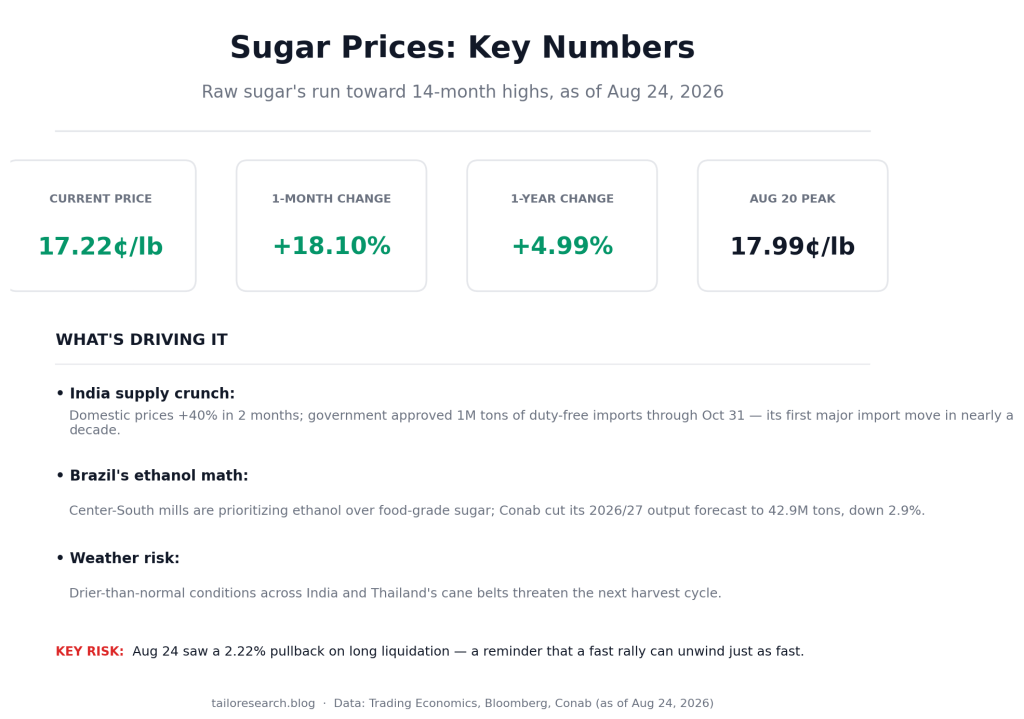
Sugar has quietly become one of the most-searched commodities on Google this week, and the chart explains why. Raw sugar futures touched their highest level in more than a year on August 20, 2026, before easing back on August 24 — but the underlying story, a supply squeeze running from India to Brazil, is still very much intact.
What’s Happening With Sugar Right Now
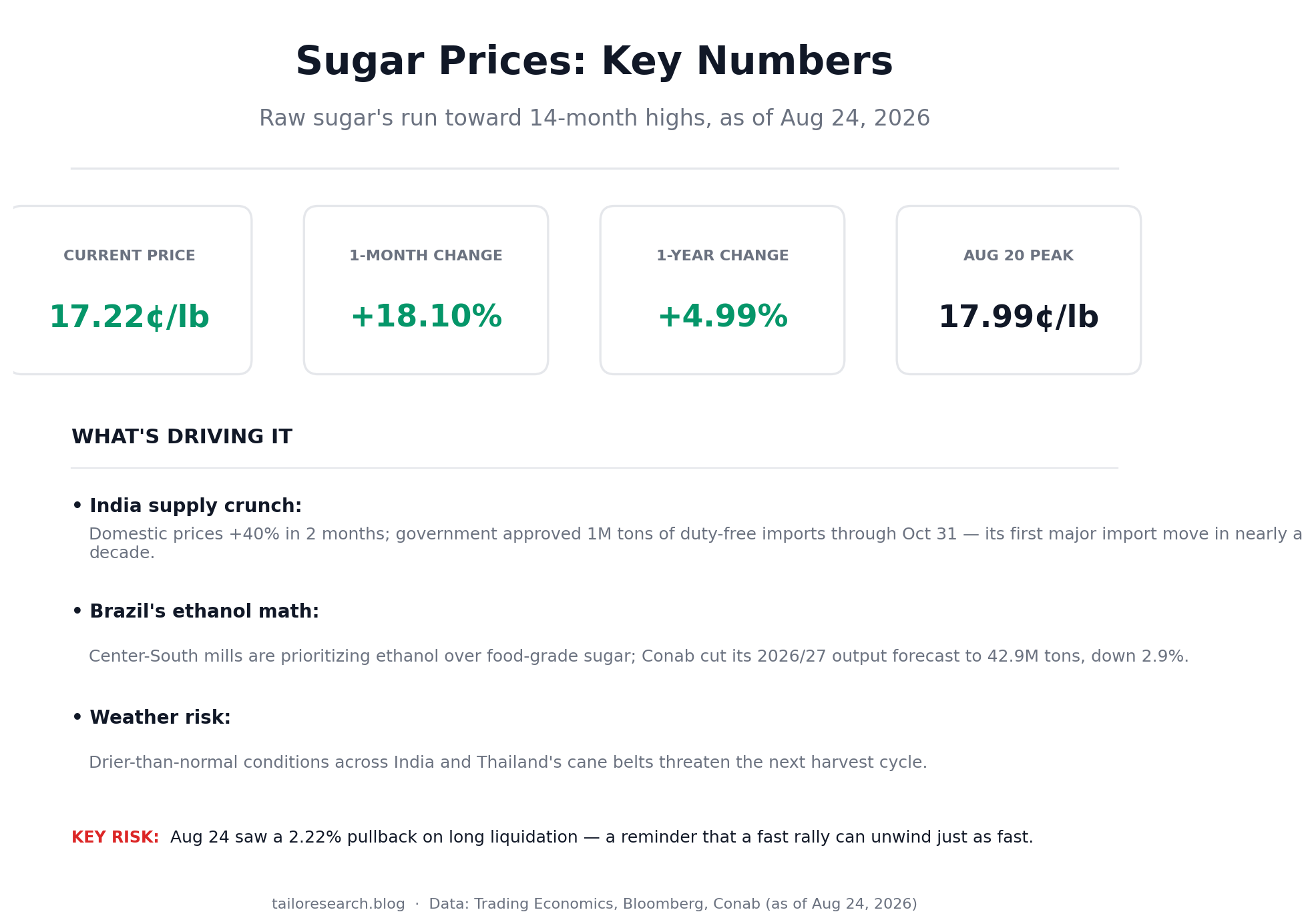
Benchmark raw sugar traded around 17.22 cents per pound on August 24, 2026, down 2.22% on the day but still up roughly 18% over the past month and nearly 5% over the past year, according to Trading Economics. Just four days earlier, on August 20, the contract hit an intraday high of 17.99 cents — its strongest level in more than 14 months. White sugar futures, the refined variety traded mostly out of Europe, pushed above $550 per metric ton over the same stretch.
India’s Supply Crunch Is the Core Driver
The proximate cause is India, the world’s largest sugar consumer and second-largest producer. Domestic Indian sugar prices have jumped nearly 40% in just two months as production has come in lower than expected ahead of the country’s peak festival-season demand. In response, New Delhi has taken a step it hasn’t taken in almost a decade: authorizing duty-free imports of up to 1 million metric tons of raw sugar through October 31, alongside new limits on how much sugar large commercial buyers are allowed to stockpile. India normally protects its domestic sugar industry with a 100% import duty, so waiving it entirely signals how tight the government believes supply has become.
Brazil Isn’t Helping — the Ethanol Trade-Off
Brazil, the world’s top sugar producer, would normally be the release valve for a shortfall like India’s. Instead, mills in the crucial Center-South growing region are leaning harder into ethanol production, which competes directly with food-grade sugar for the same raw cane. Brazil’s national supply agency, Conab, trimmed its 2026/27 sugar output forecast to 42.9 million tons, a 2.9% cut from its earlier estimate. Add in dry-weather risk across both India’s and Thailand’s cane belts, and the market has spent the past month pricing in a tighter-for-longer global supply picture.
Why Aug 24 Saw a Pullback
None of that stopped sugar from giving back some gains on August 24. Traders describe the day’s 2.22% drop as long liquidation and profit-taking after the contract ran into technical resistance near its 14-month high — a normal cooling-off period after a fast, one-directional move. India’s new import authorization and stockpile limits also took some of the most acute near-term tightness off the table, even if the medium-term supply story hasn’t changed. Momentum indicators cited by market trackers — RSI near 72, MACD still constructive — suggested the broader uptrend was intact even as the daily candle turned red.
What This Means for Traders
A few things worth watching from here:
- Follow-through on India’s import window — how quickly the 1 million tons actually lands will shape how much near-term pressure comes off prices.
- Brazil’s ethanol-versus-sugar allocation, which shifts with domestic fuel prices and can swing supply meaningfully within a single crush season.
- Monsoon and dry-season updates out of India and Thailand, since weather headlines have been the fastest way to move this market in either direction.
- Whether the pullback holds as a normal retracement or breaks the month-long uptrend — a close back below the prior support band would change the technical picture.
Sugar isn’t a market retail traders watch every day, but weeks like this are a reminder that agricultural commodities can move on the same kind of supply-and-demand mechanics as stocks — just with harvests and government policy standing in for earnings and guidance.
If you want exposure to moves like this, Vantage Markets gives you access to commodities, indices, and share CFDs with competitive spreads and fast execution. Open a free Vantage Markets account and start applying what you’ve learned.
This content is for informational and educational purposes only and does not constitute financial advice. Trading CFDs carries a high level of risk and may not be suitable for all investors. Past performance is not indicative of future results. Please read our full Risk Disclaimer and Affiliate Disclosure before making any trading decisions.
 Tailo-Research
Leave a comment